
Strip Dance vs Pole Dance: Which Should You Start With at Home?
Curious about strip dance but unsure whether you also need a pole? Here is the honest comparison — what each style actually teaches, what you can learn at home with zero equipment, and how to pick the right starting point this week.

Strip dance and pole dance get lumped together online, but they are two different skills with two very different learning curves. If you are searching from your sofa, the question is rarely "which is better" — it is "which one can I actually start tonight, in my living room, without buying a rig or signing up for a studio?" Here is the honest answer.
What strip dance actually is
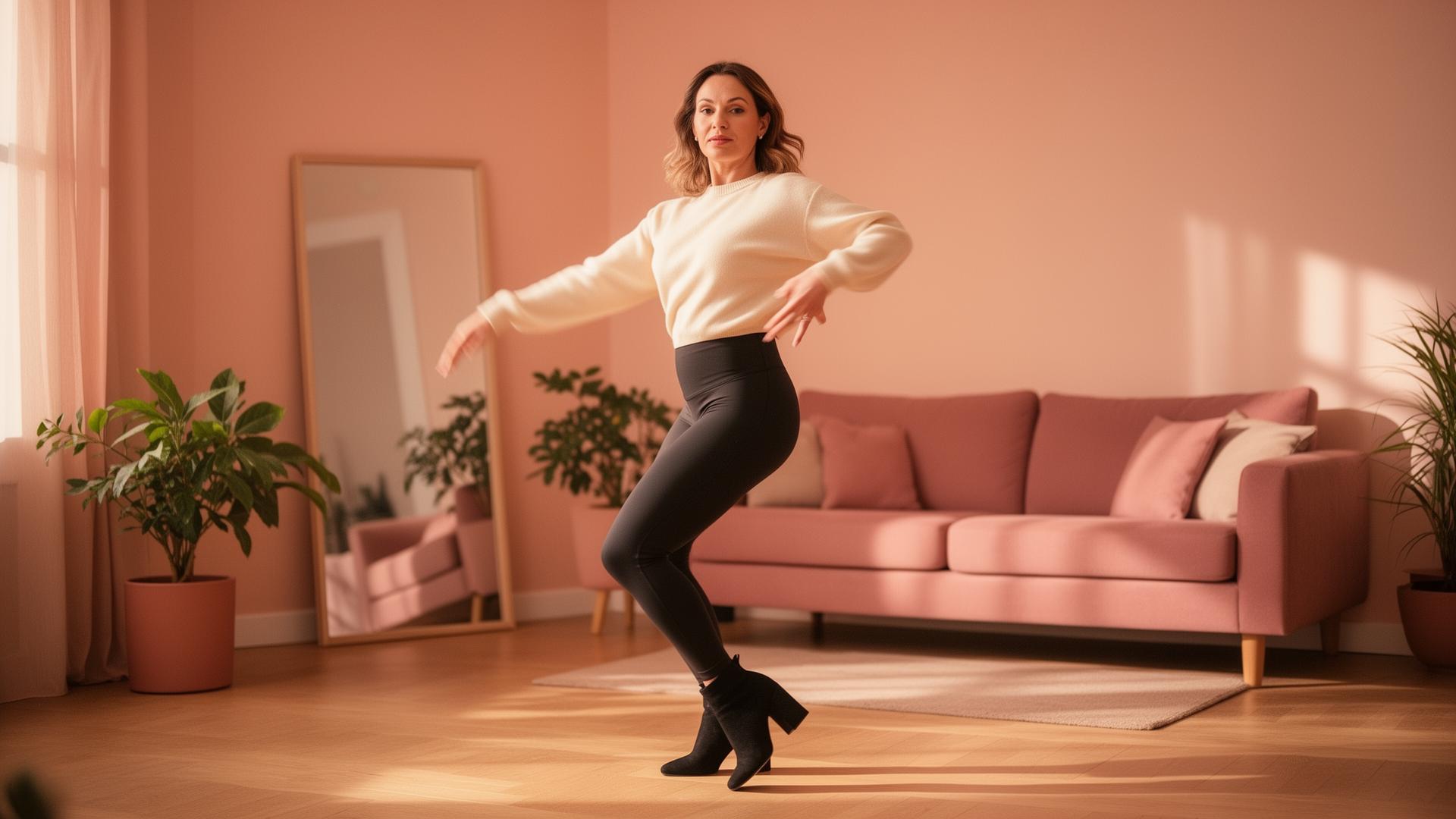
Strip dance — sometimes called exotic dance, sensual dance or "heels & floorwork" — is choreography built around walks, body waves, hair work, hip rolls, kneeling transitions and floorwork.[1] It borrows from heels, contemporary, jazz funk and burlesque. The defining feature is not the costume: it is how you move through your own body weight on the floor and in heels.
You do not need a pole. You do not need a studio. The whole vocabulary can be practised on a yoga mat in a 2 by 2 metre space.
What pole dance actually is
Pole dance is an aerial discipline. Most of the curriculum — climbs, inverts, sits, spins, holds — requires a vertical pole rated for body weight and (in modern studios) a sprung floor underneath you for safety.[2] You can learn a lot of "floor pole" choreography without leaving the ground, but the moves the world associates with pole — the spins and inverts in viral clips — require the apparatus.
Installing a stage pole at home is doable but non-trivial: ceiling height, floor type, joist location and price (a decent X-Pole is in the 300–450 USD range) all matter.[3]
The honest comparison
| Strip dance (at home) | Pole dance (at home) | |
|---|---|---|
| Equipment needed | None — bare floor or mat, optional heels | Stage pole, ~2.4 m ceiling, sturdy floor |
| Startup cost | 0–60 USD (heels + mat) | 300–500 USD + install |
| Space required | ~2 x 2 m | ~2.4 m ceiling, 1.5 m radius clear |
| Skill curve | Choreography + body awareness | Strength + grip + choreography |
| Injury surface | Knees, ankles (manageable) | Falls, shoulder/wrist load |
| Privacy at home | Easy | Hard to hide a pole from flatmates |
| Time to a full short routine | 2–3 weeks | 6–8 weeks |
Neither is "easier." But strip dance has a much shorter distance between "I want to try this" and "I am dancing through a full song in my living room."
When pole is the right answer
Pick pole if:
- You already have an active strength practice and miss the upper-body challenge.
- You have a flatmate-free space with the ceiling height for a stage pole, or a studio within easy reach.
- The specific images that pulled you in — inverts, spins, flag holds — are aerial. No amount of floorwork will replicate them.
When strip dance at home is the right answer
Pick strip dance at home if:
- You want to start this week, in clothes you already own, in the room you are in right now.
- The thing you really want is to feel sensual, grounded and in control of your own body — not to perform tricks.
- You have ever told yourself "I am not flexible / strong / coordinated enough for pole." Strip dance gives you the same emotional payoff with a softer entry.[4]
Most women who write to us about pole actually want strip dance. They want the feeling — the music, the slow walks, the moment in the mirror — not the apparatus.
A small, honest watch-list
If you want a feel for the difference before you commit, watch these two clips back to back. The first is a floorwork-led strip/heels piece, the second is an aerial pole routine. Same artistry, completely different bodies of work.
You will know within ten seconds which one your body is leaning toward.
How to start strip dance at home this week
Three honest moves that work on day one, with no pole and no choreography background:
- The walk. Cross one foot in front of the other, slow, on the beat. Eyes up. That is 80% of strip dance vocabulary.
- The body wave. Chest forward, ribs forward, hips forward — like a slow vertical wave through your spine. Practise standing, then kneeling.
- The kneel-down. From standing, step back, lower one knee, then the other. Land soft. This is the bridge into floorwork and the move most people skip.
Press play to a song you already love. Do those three for one song. That is your day one. Whether you ever buy a pole is a question for month three.
What to do next
If you have read this far, you already know the answer. Strip dance is the one you can start tonight. Pole is a project for later, if at all.
Pick a 10–15 minute beginner program, close the door, dim the lights, and dance one song. Tomorrow do it again. The hard part is not the technique — it is the first press of "play."
Sources
Put it into practice with Dance Cardio Burn.
High-energy, low-impact cardio in 20-minute sessions choreographed like a party. Fat burns, mood lifts, knees and back stay safe.
- 15 min daily sessions
- Low-impact modifications
- No equipment, 2 m²
- Cancel anytime
“Lost 3 kg without weighing food. I just kept pressing play because the music is that good.”

Sofía has choreographed for music videos and taught heels, reggaeton and hip-hop in Madrid, Mexico City and Berlin for over 15 years. At Everdance she leads the at-home heels and Latin curriculum and writes the tutorials beginners actually finish.

Helena has spent two decades editing health journalism for European magazines. She fact-checks every Everdance article against primary sources.
Keep reading
All articles →
Learn Strip Dance at Home: A Realistic 6-Week Plan (No Pole)
The Best Music for a Dance Workout at Home: BPM, Playlists & the Science of Why Tempo Matters