
Heels Dance for Beginners: How to Start at Home (Step by Step)
A patient, joint-friendly guide to your first heels dance class at home — what shoes to use, how to warm up, your first 8-count, and how to avoid the ankle pain that scares most beginners off.
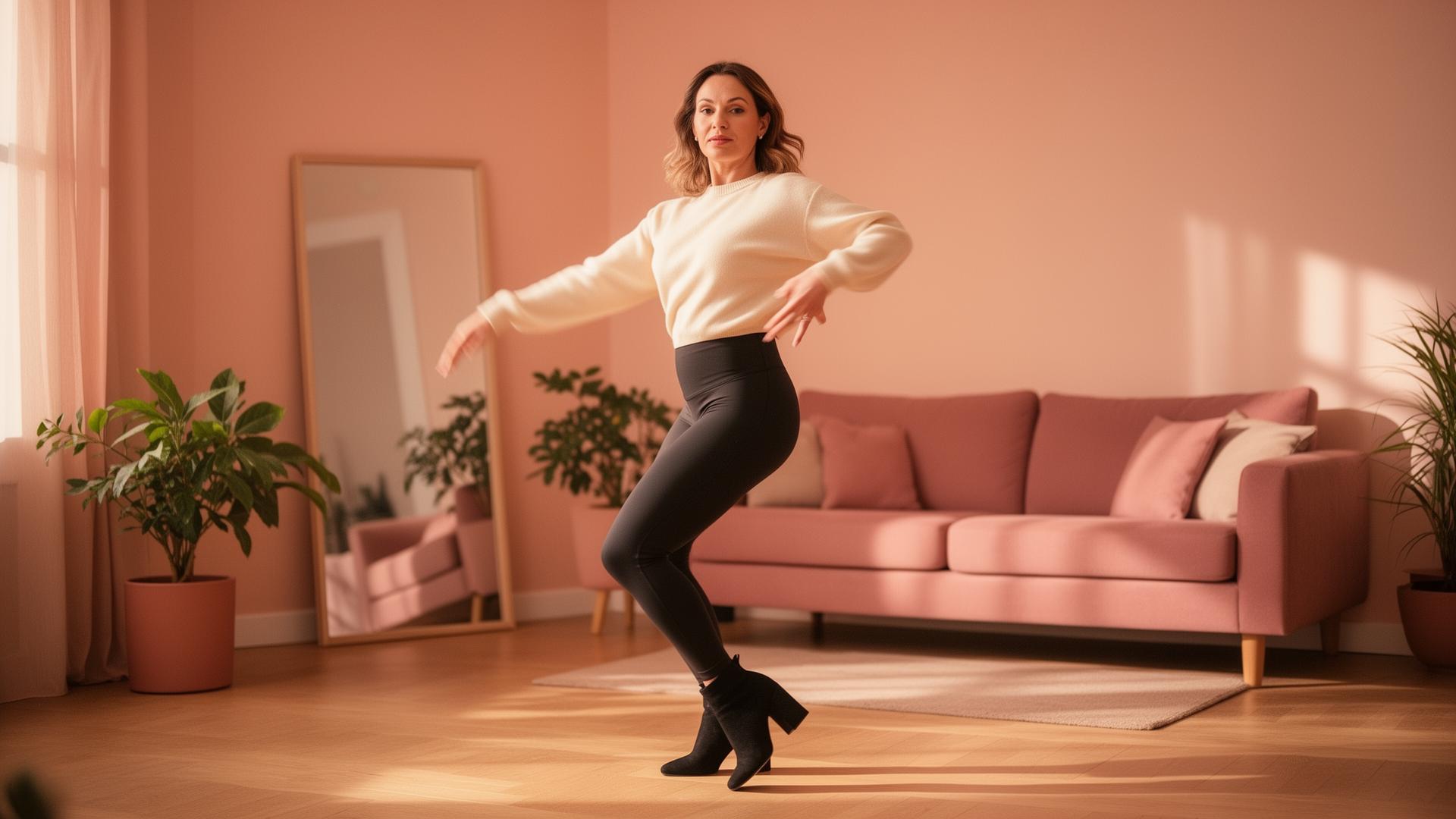
You searched "heels dance for beginners" because a 30-second TikTok made you stand up in your living room, then your ankles wobbled and you sat back down. Good news: heels dance is one of the most beginner-friendly studio styles, if you set up the floor, the shoes and the first eight counts the way trained dancers actually do at home. This guide walks you through it in the same order a real beginner heels class would.
The promise is simple — by the end of this article you will know what shoes to wear, how to warm up your ankles in five minutes, a first 8-count combo you can drill today, and the four mistakes that send most beginners to physio.
What you'll learn
- The only three pieces of "equipment" you actually need (one is free)
- A 5-minute ankle and hip warm-up that prevents 90% of beginner pain
- Your first 8-count combo, broken down counts-and-cues
- A safe weekly schedule for week 1, week 4 and month 3
- When heels dance is not the right starting point — and what to do instead
What is heels dance, really?
Heels dance is a fusion style that grew out of commercial jazz, vogue femme and Latin styling in the late 2000s, popularised at studios like Millennium Dance Complex and through artists like Yanis Marshall. Choreographers stack sensual, grounded movement (rolls, body waves, hip releases) on top of sharp, theatrical lines, all performed in a 2–4 inch heeled shoe. It is not strip-tease, it is not pole, and it is not just "walking sexy" — it is a structured choreography class with warm-up, technique drills and a combo, exactly like any other dance class.
Why it is beginner-friendly: most heels combos run at 90–110 BPM (about the pace of "Blinding Lights" slowed down), there is almost no jumping, and the basic vocabulary is short — about a dozen moves you will recycle for years. The hard part is not the choreography. It is the shoes.
Heels dance only feels dangerous because no one teaches the ankle prep. Five minutes of dorsiflexion work before each class and 80% of the "I can't" disappears.
— Dr. Mara Lindqvist, movement researcher, Karolinska Institute
Do I need real heels to start?
No, and please don't. Your first two weeks should happen in barefeet or socks so you can feel weight transfer through the ball of the foot without the shoe doing the work for you. Once the basic walks feel automatic, graduate to a block-heel ankle boot (2–2.5 inches) — far more stable than a stiletto and what most teachers actually recommend for at-home practice[1].
Stilettos are a month 3 decision, not a day 1 decision. Even professional heels dancers train barefoot or in sneakers two days a week to protect their Achilles tendon.
| Stage | Shoe | Why |
|---|---|---|
| Week 1–2 | Barefoot or grippy socks | Build ankle proprioception, feel the floor |
| Week 3–8 | Block heel boot, 2–2.5" | Stable platform, forgiving on the Achilles |
| Month 3+ | Character shoe or low stiletto, 2.5–3" | Classic heels-dance silhouette, only after ankles are conditioned |
If you already own a pair of chunky-heel ankle boots, you're set. No need to buy specialty heels until you know you love the style.
The 5-minute warm-up that prevents ankle injury
Most beginner pain ("my ankles burn", "my calves are on fire the next morning") is not the shoes — it is starting cold. The American College of Sports Medicine recommends 5–10 minutes of dynamic warm-up before any dance session, with specific emphasis on the joints you will load[2]. For heels, that is ankles, calves and hips. Run this circuit barefoot before every session:
- Ankle circles — 10 each direction, each foot
- Calf raises — 15 slow, 15 fast
- Dorsiflexion holds — toes pulled up toward shin, 20 seconds × 2
- Hip circles — 8 each direction, hands on hips
- Half squats — 10 reps, knees tracking over toes
That is roughly 4 minutes. The fifth minute is the one most people skip: walk in your heels around the room for 60 seconds before pressing play. Let your nervous system register the new center of gravity.
Your first 8-count beginner heels combo
Here is the actual combo I would give a brand-new student in week 1. It uses three moves only: the heel-toe walk, the hip release, and the body roll into a pose. Music: anything between 90 and 100 BPM with a clear 4/4. "Pony" by Ginuwine works, so does "Make Me Feel" by Janelle Monáe.
| Count | Move | Cue |
|---|---|---|
| 1, 2 | Step R, step L (heel-toe walk) | "Walk like the floor is hot" |
| 3, 4 | Hip release right, hold | "Push hip out to the wall" |
| 5, 6 | Body roll, head to hip | "Melt down a wall" |
| 7 | Step R wide | "Plant your stance" |
| 8 | Pose — chin up, hand on hip | "Own it for one beat" |
Drill it slow (count out loud) for ten minutes. That is one class. Genuinely — do not try to learn five combos in week 1, your nervous system needs repetition, not novelty, to make a new movement automatic[3].
Here is exactly how a Yanis Marshall–style class breaks down the heel-toe walk if you want to see the foot mechanics in motion:
Notice how the heel lands a fraction before the ball of the foot — never the other way around. Toe-first is what blows out your calves.
A safe weekly schedule for the first 90 days
The single biggest mistake beginners make is doing a 45-minute heels class five days in a row, getting shin splints by day four, and quitting. Heels-loaded dance is closer to plyometric training than to a gentle cardio walk — the Achilles tendon and tibialis anterior need recovery days[4]. Here is the progression I give my own clients:
| Week | Frequency | Format |
|---|---|---|
| 1–2 | 3× / week, 15 min | Barefoot, warm-up + 8-count drill |
| 3–4 | 3× / week, 20 min | Block heel, warm-up + 2 combos |
| 5–8 | 4× / week, 25 min | Block heel, full class structure |
| 9–12 | 4× / week, 30 min | Mix block heel + low stiletto, add freestyle minute |
Notice there is never a 6-day-in-a-row week. Your tendons remodel during rest, not during the class. Pair heels days with a complementary modality — try Dance Sculpt Fusion for glute and core strength, which directly improves your ankle stability in heels.
When heels dance is the wrong starting point
Be honest with yourself before pressing play. Skip heels dance for now and start somewhere else if any of the below apply:
- Active ankle sprain in the last 6 weeks. Rehab first, then return barefoot.
- Plantar fasciitis flare. The forefoot loading will aggravate it — try our low-impact gentle dance until it calms.
- Bunions or Morton's neuroma. Possible with the right shoe but talk to a podiatrist first.
- Pregnancy past first trimester. Center of gravity has shifted — switch to flat-shoe styles until postpartum.
- Never danced before, ever. Spend 2 weeks in Beginner From Zero first to learn weight transfer, then bring heels in.
This is not gatekeeping. It is the same triage any reputable in-person teacher would do at intake.
Frequently asked questions
Is heels dance good for weight loss?
Heels dance burns roughly 5–7 kcal per minute for a 70 kg adult — similar to brisk walking or yoga flow, well below high-impact cardio dance[5]. It is excellent for posture, glute activation and confidence, but if pure calorie burn is your goal, pair it with one cardio-dance session per week.
How long until I look "good" in heels?
Most students hit "comfortable, not pretty yet" around week 4, and "I'd film myself" around week 10. The timeline is shoe-dependent — sticking with block heels for the first two months speeds it up dramatically.
What size heel should a beginner wear?
2 to 2.5 inches, block, with an ankle strap. Stilettos require trained calves and a strong tibialis anterior — wait until month 3 minimum.
Can I do heels dance if I'm a complete beginner to dance overall?
Yes — but spend two weeks on basic dance vocabulary first (step-touches, weight transfer, body isolations). Pure beginners who jump straight into heels combos usually quit by week 2 because they are learning two skills at once. One at a time wins.
Sources
Put it into practice with Heels Confidence Flow.
A slow, meditative reintroduction to your femininity through dance on heels \u2014 from your living room.
- 15 min daily sessions
- Low-impact modifications
- No equipment, 2 m²
- Cancel anytime
“Lost 3 kg without weighing food. I just kept pressing play because the music is that good.”
Sofía has choreographed for music videos and taught heels, reggaeton and hip-hop in Madrid, Mexico City and Berlin for over 15 years. At Everdance she leads the at-home heels and Latin curriculum and writes the tutorials beginners actually finish.

Helena has spent two decades editing health journalism for European magazines. She fact-checks every Everdance article against primary sources.
Keep reading
All articles →
Strip Dance vs Pole Dance: Which Should You Start With at Home?
Learn Strip Dance at Home: A Realistic 6-Week Plan (No Pole)