
Seated Cardio Workout for Seniors: Get Your Heart Rate Up Without Standing
How seated cardio raises your heart rate into the moderate-intensity zone safely — with a 20-minute routine and 4 foundational movements.

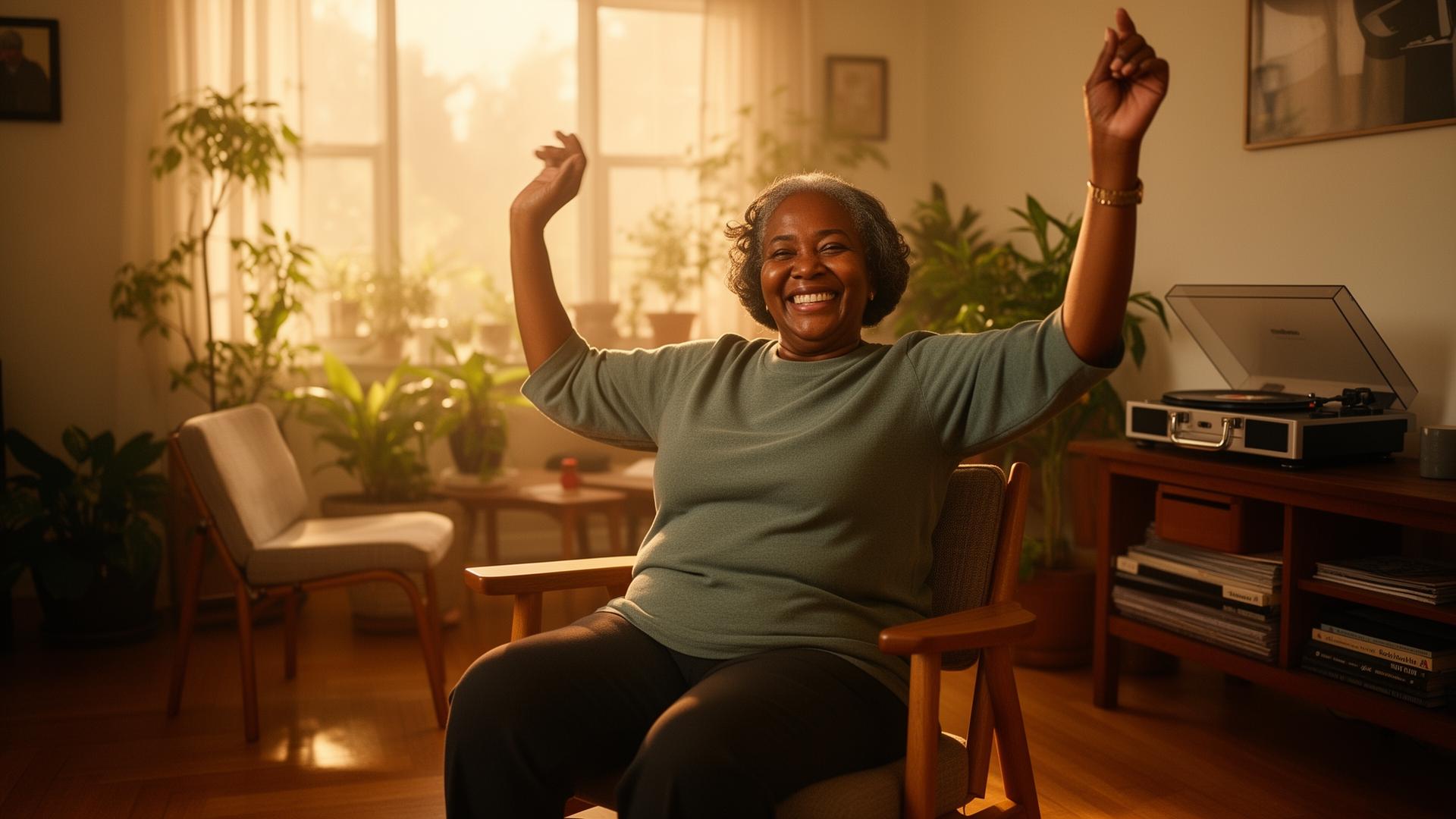
"Cardio" doesn't have to mean treadmills, jumping or anything that punishes your knees. A growing body of evidence shows that seated cardio reaches the same moderate-intensity heart rate zone as a brisk walk — without the impact, fall risk or weather dependency [1]. For adults 60+ who want a real cardiovascular workout from the safety of a chair, this is the most underused tool in fitness.
This guide explains exactly how to do seated cardio: the target heart rate, the four core movements, the 20-minute routine and how to track that it's actually working.
What "seated cardio" actually means
Seated cardio is any rhythmic, large-muscle movement performed in a chair, sustained long enough and intensely enough to raise the heart rate into the moderate-intensity zone (50–70% of your maximum heart rate). The American Heart Association recognises seated aerobic exercise as a valid form of cardiovascular training for adults with mobility limitations and sedentary lifestyles [2].
It is not:
- Slow stretching in a chair (that's mobility work)
- Single isolated movements (that's strength work)
- Chair yoga (that's flexibility + breath work)
It is continuous, rhythmic, large-muscle activity — arms swinging, knees lifting, torso twisting — sustained for 15–30 minutes per session.
"For deconditioned older adults, 20 minutes of seated cardio three times per week produces VO2 max gains roughly equivalent to a walking program of the same duration. The mechanism is identical: sustained elevation of stroke volume and heart rate." — Dr. Liam Foster, exercise physiologist, University of Edinburgh
Why your heart needs it more after 60
After 60, cardiac output declines about 5–10% per decade if no cardiovascular training is done [3]. That decline is reversible: even adults in their 80s show meaningful improvements in VO2 max within 12 weeks of consistent aerobic training [4].
The problem is that traditional aerobic options become risky or boring. Treadmills are unfamiliar. Group classes are intimidating. Walking is fine but weather-dependent and surprisingly hard on arthritic knees if you live near hills. Seated cardio solves all three by moving the workout indoors, on furniture you already own.
Find your target heart rate
For seated cardio you want 50–70% of your maximum heart rate. Quick estimate:
| Age | Estimated max HR | 50% (easy) | 60% (steady) | 70% (working hard) |
|---|---|---|---|---|
| 60 | 160 | 80 | 96 | 112 |
| 70 | 150 | 75 | 90 | 105 |
| 80 | 140 | 70 | 84 | 98 |
Don't have a heart rate monitor? Use the talk test:
- "Easy" = you can sing
- "Steady" = you can talk in full sentences
- "Working hard" = you can only say a few words at a time
Aim for "steady" most of the time, with brief pushes to "working hard". Never gasp — that's too hard.
The four foundational seated-cardio movements
Every seated cardio routine is built from variations of these four moves:
- Seated march. Lift alternating knees toward chest while swinging opposite arms. The all-purpose engine of seated cardio.
- Seated jog. Faster march; smaller movement; pump the arms harder. Spikes heart rate quickly.
- Side-to-side reach. Hands tap one knee, then reach diagonally up to the opposite ceiling corner. Adds the torso into the cardio equation.
- Knee-out / knee-in. Open both knees wide then close them, while pressing hands forward and back. Activates inner-thigh, hip and core muscles together — surprisingly tiring.
That's it. Combine these four movements with music and you have an infinite library of seated cardio routines.
A complete 20-minute routine
Warm-up (3 min) — Slow march, shoulder rolls, gentle twists. Get to "easy".
Block 1: Steady state (5 min) — Continuous seated march, swinging arms naturally. Aim for "steady" effort. If you slip down to easy, march faster.
Block 2: Intervals (6 min) — Alternate 30 seconds seated jog (working hard) with 30 seconds slow march (easy). Six rounds total. This is where the real cardiovascular gains happen.
Block 3: Patterns (4 min) — Combine moves: 8 marches → 8 side reaches → 8 knee-out/in → repeat. Coordination + cardio.
Cool-down (2 min) — Slow march down to easy, deep breathing, arms overhead stretch.
Total: 20 minutes. Do this 3× per week.
Make it actually fun: add music
The reason walking, treadmills and step aerobics feel like a chore for so many women 60+ is that they're done in silence or to generic gym music. Seated cardio set to the right music — songs your body already knows — short-circuits the boredom problem entirely.
Here's a guided seated cardio class with music and pacing cues:
This is the model the Everdance Chair Cardio Dance program uses: the four movements above, choreographed to disco, soul and Latin grooves that pull you through the 20 minutes without you noticing.
How to track that it's working
After 4 weeks of 3× per week seated cardio, you should notice at least two of these:
- Lower resting heart rate — measure first thing in the morning before getting up; a drop of 3–5 bpm is typical
- Less breathless on stairs — climbing a single flight stops feeling like a workout
- Better daytime energy — less afternoon slump
- Faster recovery — heart rate returns to baseline within 2 minutes of finishing
If you see none of these after 4 weeks, you're not working hard enough. Push more of the workout into the "steady" zone.
Common mistakes
- Going too easy the whole time. Casual marching while watching TV is movement, not cardio. You need to elevate the heart rate.
- Going too hard at the start. Sprinting for the first two minutes wrecks the rest of the workout. Warm up properly.
- Holding your breath. Common during effort — defeats the purpose. Exhale on the work, inhale on the recovery.
- Skipping the cool-down. Stopping suddenly after sustained cardio can drop blood pressure. Always taper.
- Doing it daily without rest. Cardio adaptations happen during recovery. 3–4 sessions per week beats 7.
Who should NOT do seated cardio without medical clearance
- Anyone within 6 weeks of a cardiac event
- Anyone with unstable angina or uncontrolled blood pressure
- Anyone with severe aortic stenosis
- Anyone whose doctor has restricted exercise
Get cleared first, then come back to this article.
Frequently asked
How is this different from chair yoga?
Yoga focuses on flexibility and breath; seated cardio focuses on heart rate. Different goals, both valuable. Most weeks you want both: cardio 3× and yoga or stretch 2×.
Can I do this every day?
Yes if you alternate intensity: 3 harder cardio days + 4 easier "active recovery" days (slow seated movement, walking, mobility work).
Will I lose weight with seated cardio?
A 20-minute session burns 110–150 calories for a 70 kg adult [5]. Combined with small dietary changes, that's 1.5–2.5 kg per quarter. Sustainable.
What if I get dizzy?
Stop, sit forward with head between knees, breathe slowly. If it happens repeatedly, see your doctor — it could be a blood-pressure-medication interaction.
Can I use ankle weights?
Don't. They put unnatural strain on the knee joint during the swinging motions. Use a light resistance band instead if you want more challenge — see our resistance band chair guide.
Sources
- [1]Furtado et al. Cardiorespiratory responses to seated aerobic exercise (J Aging Phys Act, 2021)
- [2]American Heart Association — Physical activity recommendations
- [3]Strait & Lakatta. Aging-associated cardiovascular changes (Heart Fail Clin, 2012)
- [4]Vigorito & Giallauria. Exercise & cardiovascular performance in elderly (Front Physiol, 2014)
Real Heart-Rate Cardio Without Standing, Set to Music You Love.
A 20-minute chair-cardio session built around the four foundational movements — marching, jogging, side reaches, knee-out/in — choreographed to disco, soul and Latin grooves. Every class hits the moderate-intensity zone without ever asking you to stand.
- Hits 60–70% of max heart rate, evidence-based dosage
- Built-in interval blocks for cardiovascular gains
- Music-led pacing — you don't watch the clock
- 3 sessions per week is all you need to see results in 4 weeks

“Lost 3 kg without weighing food. I just kept pressing play because the music is that good.”

Lena is a doctor of physical therapy (DPT) who has spent 12 years working with adults 60+ on balance, arthritis recovery, and a confident return to movement after injury. She designs Everdance's chair and low-impact programs and writes everything we publish about ageing well.

Helena has spent two decades editing health journalism for European magazines. She fact-checks every Everdance article against primary sources.
Keep reading
All articles →
Chair Exercises for Seniors with Limited Mobility (2026 Guide)

Chair Exercises for Arthritis: A Joint-by-Joint Guide for Seniors