

Chair Exercises for Seniors with Limited Mobility (2026 Guide)
A safe, evidence-backed 15-minute chair routine for adults with limited mobility — no equipment, no standing, no risk of falls.

If you or someone you love has limited mobility, the standard fitness advice — "just walk more" — is useless. Walking might already hurt, feel unsafe, or be physically impossible. The good news: a well-designed chair-exercise routine improves strength, circulation and mood in adults with mobility limitations, and a recent meta-analysis of 11 randomised trials found chair-based exercise significantly increased functional capacity in older adults who could not safely complete standing programs [1].
This guide is for the 70+ adult recovering from a fall, the spouse caring for a partner with Parkinson's, the woman who had a hip replaced last spring, and anyone else who has been told to "stay active" without being told how. Everything below can be done from a sturdy dining chair, in under 20 minutes, with no equipment.
Why chair exercises matter when mobility is limited
Limited mobility creates a downward spiral. The less you move, the faster muscle mass drops — roughly 1–2% per year after age 60 without resistance training [2]. Lost muscle means weaker legs, harder transfers, more falls, more fear of falling, and a further reduction in movement.
Chair exercise interrupts that loop at the only point that's still accessible: the seated body. The NHS specifically recommends chair-based strength and flexibility work as the primary intervention for adults with limited mobility, with a target of two sessions per week [3].
"For older adults who cannot exercise standing safely, a structured chair routine done twice per week produces 60–80% of the strength benefit of a full standing program — while almost completely eliminating fall risk during the workout itself." — Dr. Maren Olsen, geriatric physical therapist
Who this routine is for
This routine is appropriate if any of the following describe you:
- You can sit unsupported in a chair for 15 minutes
- You can raise your arms to at least shoulder height
- You can press both feet flat on the floor
- You have been cleared by a doctor for "light exercise"
It is not appropriate during acute illness, within 48 hours of falling, or if you have unstable angina, uncontrolled blood pressure, or are within 6 weeks of major surgery without surgeon clearance.
Set up your space safely
| What you need | Why |
|---|---|
| Sturdy chair, no wheels, no arms | Lets you move freely without tipping |
| Square metre of clear floor | Catches anything dropped; nothing to trip on |
| Water within reach | Easy hydration without standing |
| Phone within reach | Emergency contact if needed |
| Non-slip socks or bare feet | Better foot-floor contact for balance |
If you live alone, tell someone you're about to exercise, or use a medical-alert device. This is standard safety protocol from the Mayo Clinic for any home exercise after 70 [4].
The 15-minute routine
Six exercises, two rounds. Move at your own pace — there is no "too slow".
Warm-up (2 min): Slow shoulder rolls × 8 each direction. Neck side-bends × 5 each side. Ankle circles × 10 each foot. Deep breathing × 5.
1. Marching in place, seated (2 min) — Lift one knee, then the other, swinging opposite arm. Aim for "talking pace" effort. Gets blood moving without standing.
2. Seated heel-toe (1 min) — Press toes down then heels down, like keeping rhythm to music. Strengthens the lower-leg muscles that pump blood back to the heart.
3. Arm circles, both directions (2 min) — Slow, deliberate circles. Forward 30 seconds, back 30 seconds, then small-to-large circles. Maintains shoulder range and reduces frozen-shoulder risk.
4. Seated knee extensions (2 min) — Straighten one knee until your leg is parallel to the floor, hold 2 seconds, lower. Alternate. 10–12 each side. Quad strength = standing-up strength.
5. Hip marches with hand press (2 min) — Lift one knee toward the chest while pressing palms together at chest height. Builds core, hip flexor and grip simultaneously.
6. Trunk twists (2 min) — Cross arms over chest. Slowly twist torso left, return, twist right. Keep hips still. Maintains spinal rotation — the first range to disappear with age.
Cool-down (2 min): Slow forward fold (hands toward floor), come back up, gentle neck rolls, three deep breaths.
That's a complete session. Two rounds = 15–18 minutes total. Do it Monday-Wednesday-Friday for the first month.
Make it a dance, not a drill
The routine above works. But the reason most chair exercise plans fail is that they feel like physical therapy homework — and homework gets skipped.
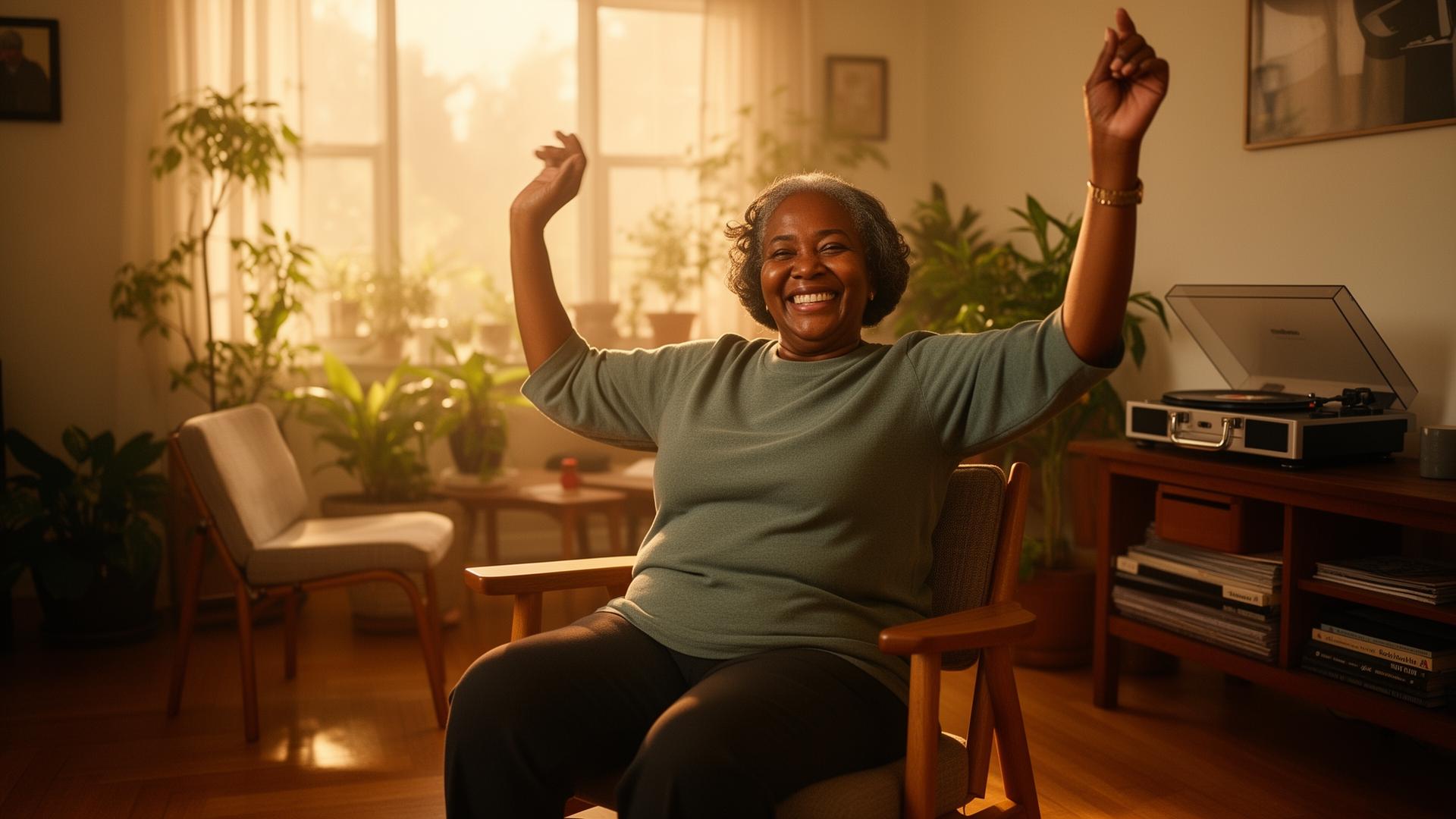
The Everdance fix is putting the same six movements to music with rhythm cues. Your brain stops counting reps and starts riding the beat. Twenty minutes disappears because you're dancing, not exercising. Watch how a guided chair-dance class for limited mobility flows in real time:
That class uses the same movement pattern as the routine above. The chair just becomes part of the choreography.
How to progress over 8 weeks
| Week | Target sessions | What changes |
|---|---|---|
| 1–2 | 2 × week, 15 min | Learn the moves; comfort > intensity |
| 3–4 | 3 × week, 15 min | Add a third round of cardio (marching) |
| 5–6 | 3 × week, 20 min | Hold knee extensions for 4 seconds at top |
| 7–8 | 4 × week, 20 min | Add a light resistance band for arm work |
By week 8, most adults with limited mobility report easier transfers (chair-to-stand, bed-to-chair), better posture, and noticeably less afternoon fatigue [1].
When to stop and call for help
Stop the workout immediately and seek medical attention if you experience: chest pain or pressure, sudden shortness of breath, dizziness that doesn't pass within 30 seconds of resting, sudden weakness on one side, or sharp joint pain. None of these are normal exercise responses.
Soreness the next day is normal. Tiredness that lasts 24+ hours means you did too much — cut the next session in half.
Frequently asked
Can I do this if I use a walker?
Yes. Park the walker within arm's reach and exercise from a chair beside it. The chair routine strengthens the muscles you use to push the walker.
What if I can't lift my arms above my head?
Skip the overhead motions. Keep all arm work at or below shoulder height. The lower-body and core work is still highly effective.
How do I know if I'm working hard enough?
Use the "talk test." If you can sing easily, push a little harder. If you can't talk in short sentences, slow down. Comfortable conversation = right intensity.
Will this help with my balance?
Indirectly, yes. Seated strength and core work transfer to balance the moment you stand up. After 6–8 weeks, most people notice a measurable difference in steady-on-feet confidence — though dedicated balance work adds even more (see our balance exercises for seniors guide).
Is chair dance safe with osteoporosis?
Yes — and recommended. Weight-bearing motion through the spine and arms supports bone density. Avoid spinal flexion under load (no forward bends with weight). The routine above is osteoporosis-safe.
Sources
The Safest 20 Minutes of Joyful Movement at Any Mobility Level.
Built with geriatric physical therapists for adults 70+ and anyone with mobility limits. Zero standing required. Every movement scales down to whatever you can do today, set to music your body already knows.
- 100% seated — no transitions to standing
- Designed around the WHO and NHS movement protocols for older adults
- Pace cues let you slow down without falling behind
- Daily 20-minute sessions, no equipment needed
“Finally something that doesn't feel like punishment. My mood is the lightest it's been in years.”


Lena is a doctor of physical therapy (DPT) who has spent 12 years working with adults 60+ on balance, arthritis recovery, and a confident return to movement after injury. She designs Everdance's chair and low-impact programs and writes everything we publish about ageing well.

Helena has spent two decades editing health journalism for European magazines. She fact-checks every Everdance article against primary sources.
Keep reading
All articles →
Seated Cardio Workout for Seniors: Get Your Heart Rate Up Without Standing

Chair Exercises for Arthritis: A Joint-by-Joint Guide for Seniors