
Dance Therapy Benefits for Adults: 11 Studies on Anxiety, Depression & Brain
A deep, evidence-led look at dance therapy benefits for adults — anxiety, depression, balance, cognition — with effect sizes from 11 meta-analyses and RCTs.
The American Dance Therapy Association defines dance therapy (or dance/movement therapy, DMT) as "the psychotherapeutic use of movement to promote emotional, social, cognitive, and physical integration of the individual." That sounds soft. The data behind it is not. Across three decades of meta-analyses and randomized controlled trials, the dance therapy benefits for adults are now mapped in effect sizes, sample sizes, and follow-up windows — for anxiety, depression, quality of life, balance, executive function, and more. This article walks through 11 of the strongest studies, organised by outcome, so you can see exactly what dance does to an adult body and mind. If you want the high-level version first, read our pillar overview — this one goes deeper.
TL;DR — what the evidence actually says
- Anxiety: the most consistent finding. Effect sizes from r = 0.70 (Ritter & Low) down to a homogeneous d = 0.30 in the 2019 update.[1][2][3]
- Depression: moderate effect (SMD = 0.36) that holds — or grows — at 22-week follow-up.[2][3]
- Quality of life: d = 0.67 across dance interventions; d = 0.51 for DMT specifically.[2][3]
- Balance in older women: +17.5 % on the Limits of Stability test after 3 months (p = 0.0059).[6]
- Parkinson's disease: +13 % on the BESTest balance score; significant gains in executive function.[4][8]
- Dual-task performance (the kind that prevents falls): ES = −0.48 on the cognitive Timed Up and Go.[9]
"DMT effects are comparable to other forms of psychotherapy and, when compared to active controls, remain effective — particularly against physical exercise and meditation."
— Koch et al., 2019 meta-analysis (Frontiers in Psychology)
What "dance therapy" actually means
Two related but distinct things sit under this umbrella. DMT is psychotherapy delivered by a trained dance/movement therapist — smaller, more consistent effects. Dance interventions are structured dance classes (ballroom, folk, Zumba, chair dance) led by an instructor — larger but more heterogeneous effects.[2] The line matters for clinicians; for an adult at home, what matters more is frequency and consistency. We unpack the definition more carefully in What is dance/movement therapy?.
Anxiety: the strongest, most consistent finding
The first meta-analysis on DMT, by Ritter & Low in 1996, reported an average effect size of r = 0.70 for anxiety reduction — large, by any standard.[1] That wasn't a fluke. Koch et al. (2014) replicated it with a moderate SMD = 0.44.[3] The 2019 update found a smaller but tighter effect (d = 0.30, I² = 3.47 %), meaning the result is consistent across clinical settings — exactly what you want from an intervention you might prescribe.[2]
Practical translation: across 21 DMT studies, dance reliably calms anxious adults. Not as a one-off, but as a repeatable, dose-response effect.
Depression: moderate effects that hold up at follow-up
Koch et al. (2014) pooled depression outcomes at SMD = 0.36 with zero heterogeneity (I² = 0 %).[3] The 2019 update went further: depression reductions remained stable or slightly increased at an average 22-week follow-up.[2] Pinniger et al.'s tango trial, included in the update, found effects had tripled by follow-up — attributed to ongoing mindfulness and the social bonds formed in class.[2]
For deeper Parkinson's-specific context, Zhang et al. (2019) found positive trends for depression reduction, though not uniformly significant across studies.[4] If depression is your primary concern, we wrote a focused post: Dance Therapy for Depression.
Quality of life and well-being
Two meta-analyses, same direction. Koch 2014: SMD = 0.37 for quality of life (I² = 0 %).[3] Koch 2019: a medium-to-large d = 0.67 overall, with a homogeneous d = 0.51 in DMT-only studies.[2] Well-being, mood, and affect saw a smaller SMD = 0.30 in 2014, but the 2019 update added that dance also improves interpersonal and cognitive skills (clinical-outcome d = 0.56).[2][3]
Balance and mobility in older adults
Cepeda et al. tracked women over 60 through a 3-month dance therapy program (three 45-minute sessions per week). The Limits of Stability test — a clinically validated measure of dynamic balance — improved 17.5 % (p = 0.0059).[6] Krampe et al.'s pilot RCT of the Lebed Method in adults averaging 85 years old showed mild-to-moderate effect sizes on forward reach, backward reach, and mobility, even without reaching statistical significance in a small sample.[5]
The takeaway for anyone helping an older parent: a structured dance program at the right frequency moves balance metrics that predict falls. We cover seated variants in Balance Exercises for Seniors: Dance.
Parkinson's disease: balance, gait, executive function
Dance is one of the most-studied non-pharmacological interventions in PD. Batson et al. ran improvisational DMT for adults with mid-to-severe Parkinson's: BESTest balance scores rose 13 % (p < 0.0001), and SCOPA-Cog cognition — especially executive function — also improved significantly (p = 0.0299).[8] Zhang's meta-analysis confirmed dance therapy significantly improves executive function in PD (WMD = 1.17, 95 % CI 0.39–1.95, p = 0.003, I² = 0 %).[4] Lachance et al.'s 12-week, twice-weekly protocol pushed all 5 participants to large Mini-BESTest gains.[7]
If a family member has PD, the at-home protocol is here: Dance for Parkinson's at Home.
Cognition and dual-task performance
Dual-tasking — walking while talking, stepping while counting — is the cognitive load that real life requires and that falls expose. Martin-Martínez et al. pooled five studies (n = 205) and found dance interventions significantly improved cognitive Timed Up and Go performance: ES = −0.48 (95 % CI −0.88 to −0.08, p = 0.01).[9] Batson's improvisational DMT trial saw the biggest cognitive gains on the "fist-edge-palm" executive task — exactly the kind of motor-cognitive integration dance trains.[8]
Social, interpersonal, and body image
Koch 2014 reported a moderate effect on interpersonal competence (SMD = 0.45), though heterogeneous (I² = 52 %) because of how differently studies measured "social skills."[3] The 2019 update found a large but heterogeneous d = 1.65 for dance interventions on interpersonal skills.[2] Body image moves more slowly: SMD = 0.27 in 2014, consistent across 6 studies — and Lewis & Scannell observed bigger changes in people who had been dancing for at least five years, suggesting body image is a long-game outcome.[3]
How big are these effects, really?
| Meta-analysis | Outcome | Effect size | Consistency |
|---|---|---|---|
| Ritter & Low (1996)[1] | Overall, adults | r = 0.47 | — |
| Ritter & Low (1996)[1] | Anxiety | r = 0.70 | — |
| Koch et al. (2014)[3] | Anxiety | SMD = 0.44 | homogeneous |
| Koch et al. (2014)[3] | Depression | SMD = 0.36 | I² = 0 % |
| Koch et al. (2014)[3] | Quality of life | SMD = 0.37 | I² = 0 % |
| Koch et al. (2014)[3] | Interpersonal competence | SMD = 0.45 | I² = 52 % |
| Koch et al. (2014)[3] | Body image | SMD = 0.27 | I² = 11 % |
| Koch et al. (2019)[2] | DMT, overall | d = 0.30 | I² = 3.47 % |
| Koch et al. (2019)[2] | Dance interventions | d = 0.81 | heterogeneous |
| Koch et al. (2019)[2] | Quality of life | d = 0.67 | — |
In behavioural-science terms, SMD/d ≈ 0.30 is small-but-meaningful (think: psychotherapy vs waitlist), 0.50 is moderate, 0.80 is large. Dance therapy sits between psychotherapy and exercise — and outperforms physical exercise and meditation as active controls for several outcomes.[2][3]
Who benefits most, and how often should you dance?
The moderators are clear and practical:
- Frequency: Twice-weekly sessions outperform once-weekly.[7][10]
- Population: Effects are smaller in severely impaired clinical populations — but more clinically relevant when they happen there.[2]
- Intervention type: DMT (therapist-led) is smaller and tighter; dance classes (instructor-led) are larger and noisier.[2]
- Comparator: Effects hold up against active controls (exercise, meditation), which means dance is doing something specific, not just "any movement is good."[2][3]
- Measurement: Observation-rated outcomes show bigger effects than self-report, hinting at some expectancy — but the cognitive and balance gains come from objective tests.[2]
FAQ
Is dance therapy evidence-based?
Yes — across three meta-analyses spanning more than 20 studies, dance therapy and dance interventions show consistent, statistically significant effects on anxiety, depression, quality of life, balance, and executive function in adults.[1][2][3]
How long until dance therapy works?
Several trials report meaningful changes within 3 months at 2–3 sessions per week. Koch's 2019 follow-up data show effects persist or grow at an average of 22 weeks post-intervention.[2][6]
Is dance therapy as effective as exercise or meditation?
Meta-analytic data say yes — and in some outcomes, more effective. When compared against active control groups (including exercise and meditation), DMT and dance interventions remained significantly beneficial, particularly for anxiety and quality of life.[2][3]
Can I do dance therapy at home without a therapist?
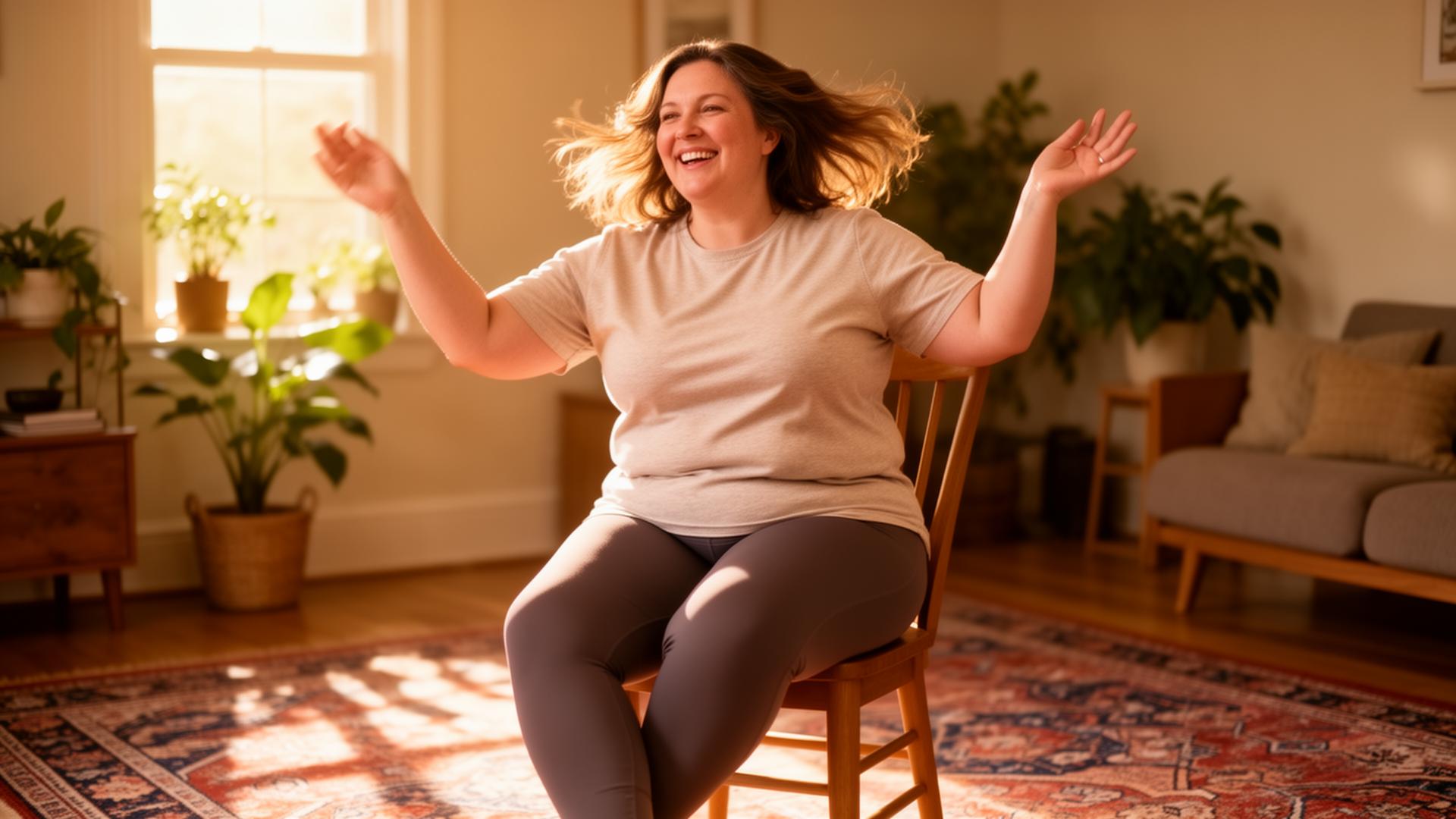
A formal DMT session needs a credentialed therapist. But the dance intervention arm of the research — the one with the larger effect sizes — is essentially structured dance practice. Twice-weekly, follow-along sessions in your living room (chair dance counts) match the protocol design used in many of these studies.[2][7]
The bottom line
- Anxiety, depression, and quality of life are the highest-evidence outcomes.
- Balance and executive function are the highest-stakes outcomes — they predict independence as you age.
- Twice a week, 12 weeks is the dose that shows up most often in successful trials.
- You don't need a studio. You need consistency, music, and a body willing to move — exactly what a follow-along dance app is designed for.
Sources
- [1]Ritter & Low, 1996 — Effects of dance/movement therapy: A meta-analysis
- [2]Koch et al., 2019 — DMT and Dance on Health-Related Psychological Outcomes: A Meta-Analysis Update
- [3]Koch et al., 2014 — Effects of DMT and dance on health-related psychological outcomes
- [4]Zhang et al., 2019 — Dance therapy on cognition and mood in Parkinson's disease
- [5]Krampe et al., 2013 — Dance-based therapy on balance and mobility in older adults
- [6]Cepeda et al., 2016 — Dance therapy on balance of women over 60
- [7]Lachance et al., 2020 — Clinical dance therapy on mobility in neurological conditions (SCED)
- [8]Batson et al., 2020 — Improvisational DMT on balance and cognition in Parkinson's
- [9]Martin-Martínez et al., 2020 — Dance therapies on motor-cognitive dual-task performance
- [10]Lachance et al., 2020 — Dance therapy as adjunct to rehab of adults with physical disability
- [11]Anderson & Davis, 2015 — DMT influence on adolescents' math and social-emotional skills
Put it into practice with Dance Cardio Burn.
High-energy, low-impact cardio in 20-minute sessions choreographed like a party. Fat burns, mood lifts, knees and back stay safe.
- 15 min daily sessions
- Low-impact modifications
- No equipment, 2 m²
- Cancel anytime
“Lost 3 kg without weighing food. I just kept pressing play because the music is that good.”

Mara studies how short bouts of rhythmic movement affect mood and cognition. She has authored over 40 peer-reviewed papers and dances daily in her kitchen.

Helena has spent two decades editing health journalism for European magazines. She fact-checks every Everdance article against primary sources.
Keep reading
All articles →
Is Dancing Good Exercise? What the Research Says
How Many Calories Does Dancing Burn? (by Style, 30 and 60 Minutes)