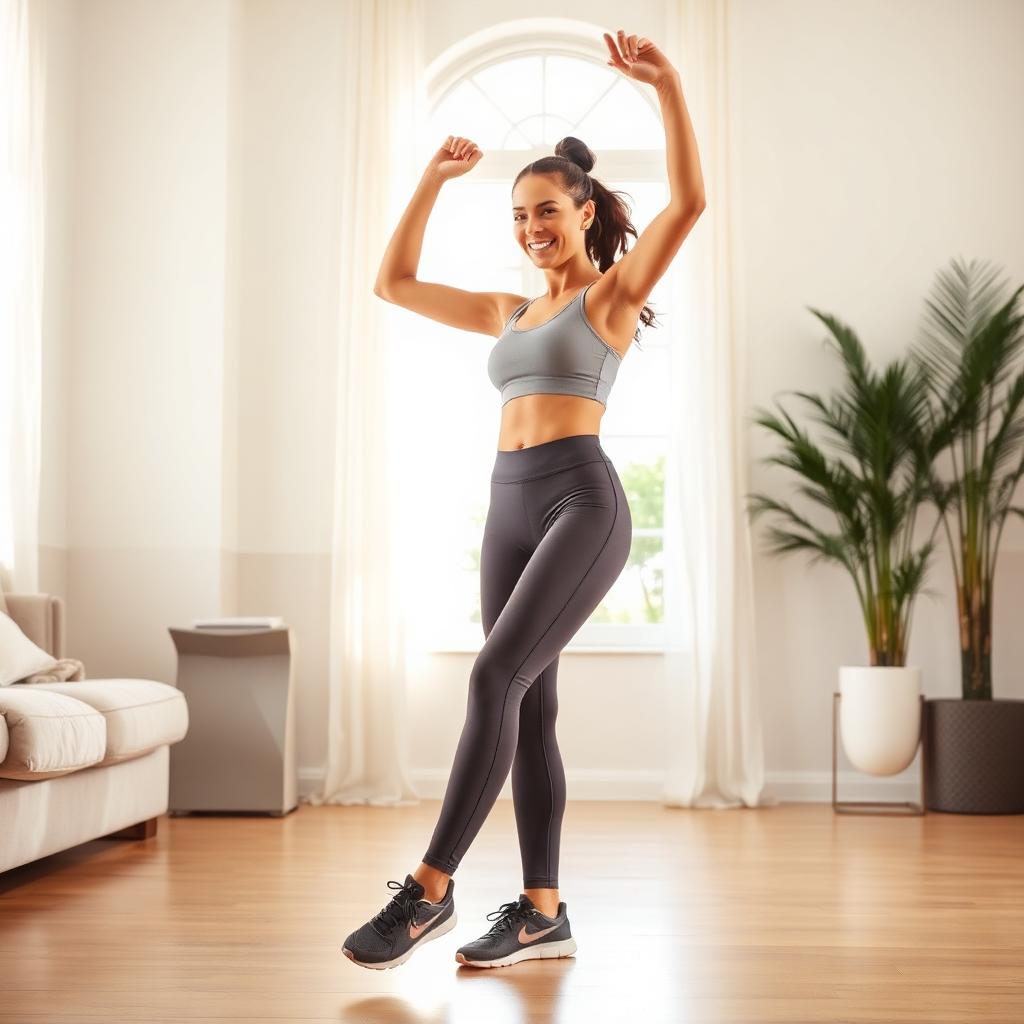

Balance Exercises for Seniors: A Dance-Based Guide
Why balance training is the single highest-impact thing you can do to prevent falls after 65 — and why dance-based balance work outperforms standard routines.
A bad fall is the event that ends more independent lives than any other. In adults 65+, falling is the leading cause of injury-related death [1]. And of all the things that prevent falls — vision care, home safety, medication review — balance dance flow training has the largest single effect [2].
Balance training, done right, isn't about wobble boards. It's about training the small stabilizer muscles in your ankles, the proprioception (your body's awareness of itself in space), and the reflexes that catch you when you trip. A well-designed seated chair workouts-and-standing dance flow trains all three, at a pace that doesn't frighten the nervous system.
This guide explains what works, why dance specifically beats most balance routines, and how to start without ever leaving the support of a chair.
What "balance" actually is
Balance isn't one thing. It's the coordination of:
- Vestibular input (your inner ear)
- Visual input (your eyes)
- Proprioceptive input (sensors in muscles and joints reporting position)
- Motor output (the muscles that respond, mostly in ankles and hips)
Aging affects all four. Vestibular hair cells decline. Vision gets less reliable, especially in low light. Proprioception fades, particularly in feet. Reaction time slows.
The good news: every one of those can be trained back, partially or fully [3]. The brain remains plastic; the stabilizer muscles remain trainable; the reflexes can be re-sharpened.
Why dance works better than most balance exercises
Most "balance exercises for seniors" are static: stand on one foot, hold for 30 seconds. Those work, but only for the specific skill of standing on one foot. They don't transfer well to the real-world balance challenges of stepping over a curb or turning quickly to catch something.
Dance is different. Dance requires:
- Weight shifts in multiple directions
- Eye-tracking while moving
- Tempo changes that train reaction time
- Coordination of arms and legs
That's why dance-based balance programs outperform standard balance routines in head-to-head trials [4]. A 2015 meta-analysis of 18 dance interventions for older adults found significant improvements in static balance, dynamic balance, AND functional mobility — three outcomes that don't always move together [5].
The 2020 update of the Cochrane review on exercise to prevent falls in older adults ranked dance-based interventions among the most effective categories [6].
How to add balance training safely at a chair
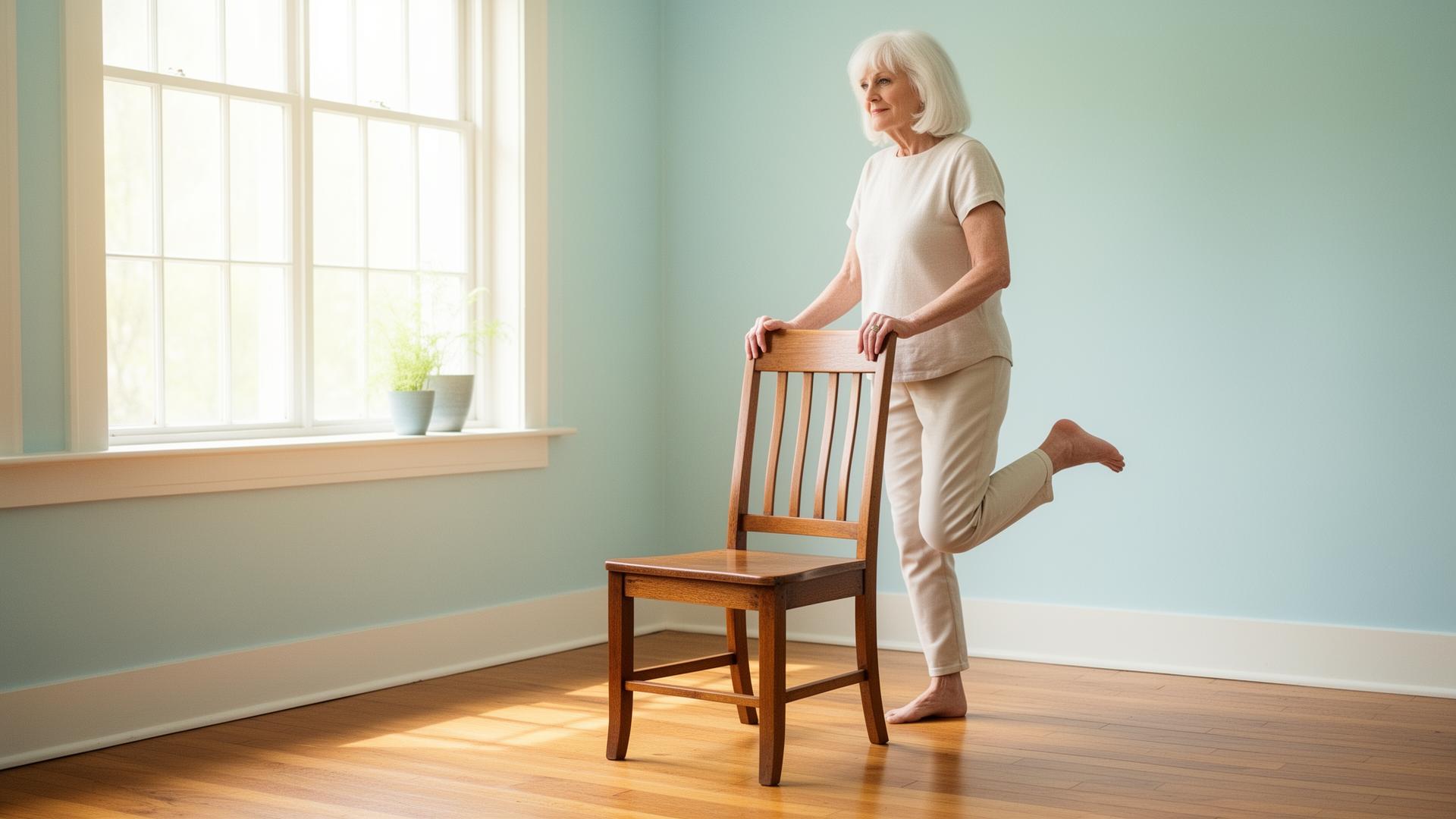
The rule: your hands should always be able to reach the chair within one step. You don't need to be holding the chair — you need to be able to.
Progressions, easiest to hardest:
- Seated weight shifts — sit, lean weight onto one sit bone, then the other. Trains the trunk.
- Seated marching with arm patterns — coordination on a stable base.
- Standing at the chair, both hands on back — heel raises, toe raises, mini squats.
- Standing at the chair, one hand on back — side leg lifts, knee lifts.
- Standing at the chair, fingertips on back — light support only.
- Standing next to the chair, hands free — chair available if needed.
Most seniors can do steps 1–3 from week one. Steps 4–6 are where the real fall-prevention work happens, and most people get there within 4–6 weeks of consistent practice.
A four-week balance-dance progression
Week 1: Seated work only. Weight shifts, ribcage circles, trunk rotation. 20 minutes, daily.
Week 2: Add standing-at-chair with both hands on back. Heel raises, mini squats, simple steps to the side. 22 minutes, daily.
Week 3: One hand on chair back. Add knee lifts, side leg lifts, simple turns. 22 minutes, daily.
Week 4: Fingertips on chair, more dance-like sequences. Trunk twists with steps. 25 minutes, daily.
Beyond week 4: keep cycling through these as you have energy. Don't rush to the next stage — repetition is what builds the reflexes.
The most important balance exercise nobody does
It's called the tandem stance: stand with one foot directly in front of the other, heel touching toe, like you're on a tightrope. Hold for 10 seconds, switch which foot is in front.
This single position trains the ankle stabilizers harder than almost anything else. Hold the chair back with both hands while you learn it; one hand once you're steady; no hands once you're confident. It takes less than a minute per session and the research on it is strong [7].
Signs your balance is improving
You won't feel it in the dramatic ways the fitness industry promises. The real signs are quieter:
- You stop bracing on furniture as you walk through the house
- You turn around faster without thinking about it
- Climbing stairs feels less effortful
- You stop avoiding curbs, uneven sidewalks, low light
These changes usually appear in week 6–8. By week 12, most participants in clinical trials show measurable improvement in the standardized Berg Balance Scale [8].
When to call your doctor before starting
Talk to your doctor first if:
- You've fallen in the last 6 months
- You take medications that cause dizziness (some blood pressure drugs, sedatives, antihistamines)
- You have neuropathy in your feet (common with diabetes)
- You feel dizzy when standing up from sitting
None of those rule out balance training. They mean you should start more slowly and have a check-in.
The honest cost of not training balance
Of seniors who fall and break a hip, roughly one in four dies within a year. Half never walk independently again [9]. The cost of prevention is twenty minutes a day. The cost of not preventing is enormous.
A chair, twenty minutes, daily. That's the protocol. Music helps it not feel like medicine.
Sources
- CDC. Older adult fall prevention. WISQARS data, 2024.
- Sherrington C, Fairhall NJ, et al. "Exercise for preventing falls in older people living in the community." Cochrane Database Syst Rev, 2019.
- Granacher U, Muehlbauer T, Gruber M. "A qualitative review of balance and strength performance in healthy older adults." Front Physiol, 2012.
- Hwang PW, Braun KL. "The effectiveness of dance interventions to improve older adults' health: a systematic literature review." Altern Ther Health Med, 2015.
- Fernández-Argüelles EL et al. "Effects of dancing on the risk of falling related factors of healthy older adults: a systematic review." Arch Gerontol Geriatr, 2015.
- Sherrington C et al. Cochrane review: exercise for falls prevention. 2019 (updated 2020).
- Sibley KM, Beauchamp MK, et al. "Components of standing postural control evaluated in pediatric balance measures: a scoping review." Phys Ther, 2014.
- Berg KO, Wood-Dauphinee SL, et al. "Measuring balance in the elderly: validation of an instrument." Can J Public Health, 1992.
- Hayes WC, Myers ER, et al. "Etiology and prevention of age-related hip fractures." Bone, 1996.
Expert perspective
Balance is a skill, not a gift. The single biggest predictor of falls after 65 is how rarely the person practises shifting their weight. A dance routine teaches that exact skill in disguise — which is why my patients stick with it.
— Dr. Mara Lindqvist, movement physiologist, Everdance
A gentle seated cardio + balance session you can do today in your kitchen:
Related: Adults with Parkinson's disease see even larger balance gains from dance — BESTest balance scores jumped from 79% to 92% in a 10-week dance/movement therapy trial. See our dance for Parkinson's at-home guide for the full protocol.
Put it into practice with Dance Cardio Burn.
High-energy, low-impact cardio in 20-minute sessions choreographed like a party. Fat burns, mood lifts, knees and back stay safe.
- 15 min daily sessions
- Low-impact modifications
- No equipment, 2 m²
- Cancel anytime
“Lost 3 kg without weighing food. I just kept pressing play because the music is that good.”

Lena is a doctor of physical therapy (DPT) who has spent 12 years working with adults 60+ on balance, arthritis recovery, and a confident return to movement after injury. She designs Everdance's chair and low-impact programs and writes everything we publish about ageing well.

Helena has spent two decades editing health journalism for European magazines. She fact-checks every Everdance article against primary sources.
Keep reading
All articles →
Is Dancing Good Exercise? What the Research Says
How Many Calories Does Dancing Burn? (by Style, 30 and 60 Minutes)