
Dance for Parkinson's: At-Home Routines That Match the Research
A growing body of research shows that short, joyful movement sessions can rewire your mood, sharpen memory and improve sleep — without a single gym visit.
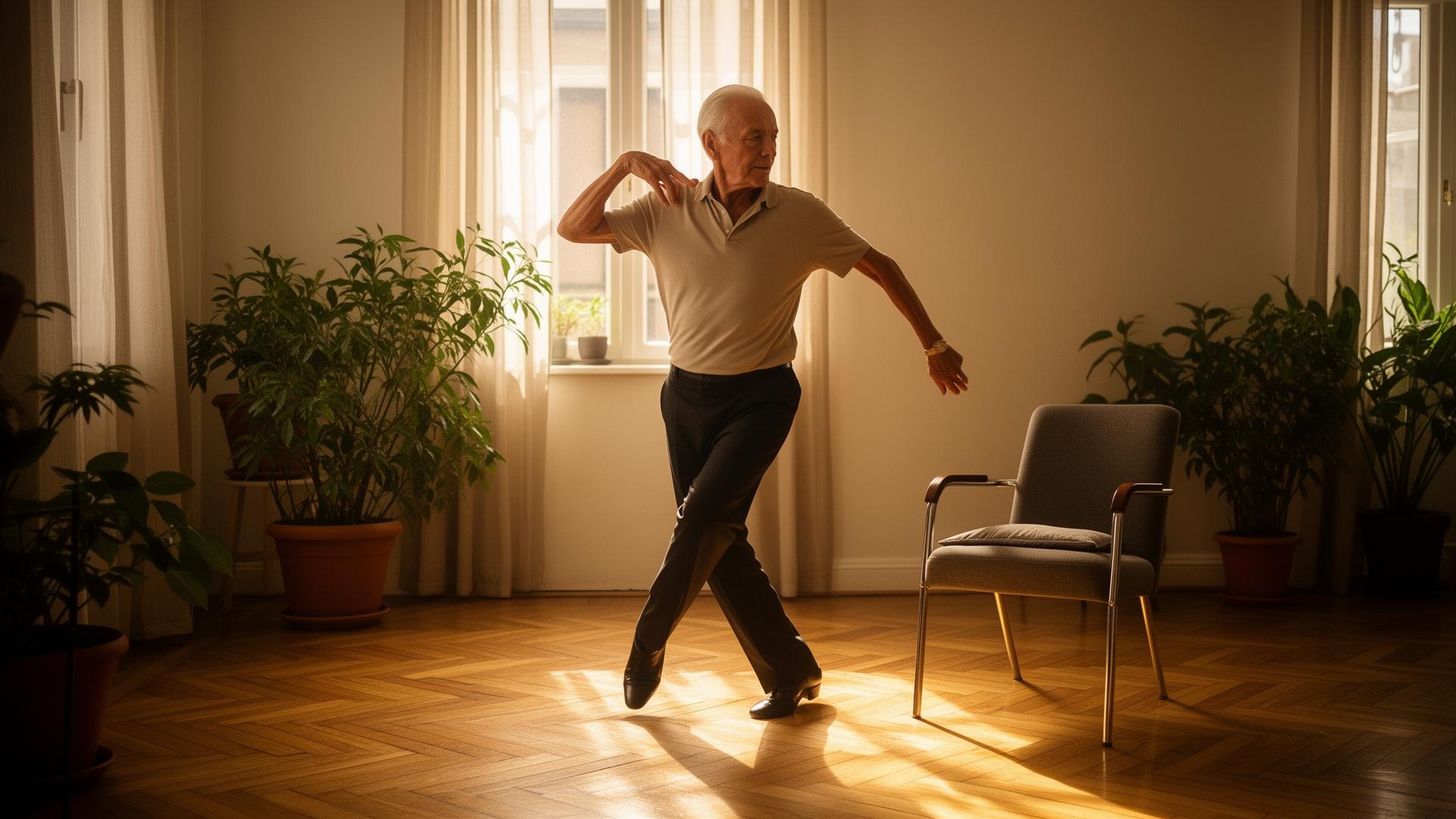
Dance for Parkinson's is one of the best-evidenced non-pharmacological interventions in modern neurology. The rhythmic, externally-cued nature of dance bypasses the broken internal timing of the Parkinsonian motor system — and the result, across more than a decade of trials, is faster walking, better balance, sharper executive function, and higher mood.
This guide turns that evidence into a workable at-home protocol for someone with Parkinson's disease.
Why does dance help Parkinson's?
Parkinson's disease damages the basal ganglia, the brain region that supplies internal rhythm to movement. Patients lose what neurologists call internal cueing — the automatic timing that lets you walk, turn, or initiate movement without thinking. Dance provides an external cue: the beat of the music does the timing your basal ganglia can no longer reliably do [1].
The evidence:
| Trial | Population | Result |
|---|---|---|
| Bouquiaux et al., 16 weeks [2] | Adults with PD rehearsing a performance | 10-m walk time 8s → 6s; happiness 6 → 7.75/10 |
| Zhang meta-analysis, 2019 [1] | PD patients across multiple trials | Executive function MD = 1.17 (95% CI 0.39–1.95) |
| Fisher DMT, 10 weeks [3] | Moderate-to-severe PD | BESTest balance 79.1% → 92.1%; SCOPA-Cog 56.7% → 62.2% |
These are not trivial gains. A jump from 79% to 92% on BESTest crosses the clinical threshold for "high fall risk" to "low fall risk."
External cueing through music is one of the most reliable tools we have for Parkinsonian gait. Dance is just a more enjoyable way to deliver it.
— Dr. Mara Lindqvist, movement physician
Which dance styles are best for Parkinson's?
Three styles dominate the published evidence:
- Tango — popularised by the Dance for PD program at Mark Morris Dance Group. Strong evidence for balance and gait.
- Ballet-based barre work — supports postural alignment and reduces freezing.
- Improvisational DMT — Fisher's data shows the largest gains in balance plus cognition [3].
The common thread is rhythmic, predictable, externally-cued movement — not the style itself.
Dance for Parkinson's at home: a 4-week protocol
The published trials ran 60-minute classes 1–2 times per week. A workable at-home approximation:
- Week 1: 10 minutes/day, seated chair dance, focus on upper body and rhythm. The chair is your safety net for the whole protocol.
- Week 2: 15 minutes/day, add gentle standing-with-chair-support segments.
- Week 3: 20 minutes/day, longer standing intervals, light tango or ballroom footwork patterns.
- Week 4: 25 minutes/day, mix seated, standing-supported, and free-standing dance. Add a weekly balance-focused session (see our balance exercises for seniors guide).
A gentle moderate-intensity flow to start with — chair-supported, follow-along:
Critical safety note: never train alone if you have moderate-to-severe PD or have fallen in the last six months. A spotter — partner, family member, neighbour on FaceTime — is non-negotiable.
How much dance is enough? The dose-response evidence
Across the trials in this article, the minimum dose that produced clinical gains was approximately:
- 60 minutes of dance per week for at least 10 weeks [1][3]
- Equivalent at home: 15 minutes most days, sustained for 2–3 months
Bouquiaux's 16-week program is the upper end of the published range and produced the largest gait gains [2].
How dance therapy compares to other PD interventions
| Intervention | Effect on balance | Effect on gait | Effect on mood |
|---|---|---|---|
| Standard physiotherapy | Moderate | Moderate | Small |
| Treadmill training | Small | Moderate | Small |
| Dance / DMT | Large [3] | Large [2] | Large [2] |
| Tai chi | Moderate | Moderate | Moderate |
The dance advantage is largest in the mood column. Parkinson's frequently brings depression, and the dance literature is one of the few that treats both at once.
Safety: when to not dance at home
Some people with PD should only dance in a supervised setting:
- Frequent freezing-of-gait episodes
- Two or more falls in the past six months
- Significant postural instability (Hoehn and Yahr stage 4+)
- Orthostatic hypotension that has caused fainting
For everyone else, a chair-supported at-home practice with a spotter on call is both safe and well-evidenced.
What about caregivers?
The Bouquiaux performance trial included caregivers in the dance program. Their mood scores improved alongside patients' [2]. If you are the spouse, child, or friend doing the spotting — dance the routine too. The cardiovascular and mood benefits documented in our pillar review apply to you.
Read next: The science of dance for adult health · What is dance/movement therapy? · Dance therapy for depression.
Frequently asked questions
Is dancing good for Parkinson's?
Yes — and the evidence is strong. A 2019 meta-analysis confirmed significant improvements in executive function (MD = 1.17) [1]. Trials show better balance, faster walking, and higher happiness scores in 10–16 weeks of structured dance [2][3].
What is the best dance for Parkinson's?
Tango has the most published evidence, followed by ballet-based and improvisational DMT. The active ingredient is rhythmic, externally-cued movement — not the specific style.
Can someone with Parkinson's dance at home?
Yes, with a chair for support and a spotter on call. Start seated for the first week, progress to standing-with-chair-support, then free-standing as balance allows. Avoid solo at-home dancing if you have had a recent fall or freeze frequently.
How often should someone with Parkinson's dance?
The published evidence supports 60 minutes per week minimum, sustained for at least 10 weeks [1]. A daily 15-minute at-home practice meets that dose with better adherence.
Does dance help cognitive symptoms in Parkinson's?
Yes. Zhang's meta-analysis showed a mean difference of 1.17 on executive-function tests (95% CI 0.39–1.95) [1], and Fisher's DMT program raised SCOPA-Cog scores from 56.7% to 62.2% in 10 weeks [3].
Further reading: Dance Therapy Benefits for Adults — 11 studies, effect sizes, what they mean
Sources
- [1]Zhang Q. et al. Effects of dance therapy on cognitive and mood symptoms in Parkinson's disease: A meta-analysis. Complementary Therapies in Clinical Practice, 2019, 36: 12–17.
- [2]Bouquiaux O. et al. Dance training and performance in patients with Parkinson disease. Science & Sports, 2022, 37(1): 45–50.
- [3]Fisher M. et al. Effects of Improvisational Dance Movement Therapy on Balance and Cognition in Parkinson's Disease. Physical & Occupational Therapy in Geriatrics, 2020, 38(4): 385–399.
Put it into practice with Dance Cardio Burn.
High-energy, low-impact cardio in 20-minute sessions choreographed like a party. Fat burns, mood lifts, knees and back stay safe.
- 15 min daily sessions
- Low-impact modifications
- No equipment, 2 m²
- Cancel anytime
“Lost 3 kg without weighing food. I just kept pressing play because the music is that good.”

Mara studies how short bouts of rhythmic movement affect mood and cognition. She has authored over 40 peer-reviewed papers and dances daily in her kitchen.

Helena has spent two decades editing health journalism for European magazines. She fact-checks every Everdance article against primary sources.
Keep reading
All articles →
Is Dancing Good Exercise? What the Research Says
How Many Calories Does Dancing Burn? (by Style, 30 and 60 Minutes)