
Low-Impact Cardio for Women Over 40: A Joint-Friendly Guide That Actually Raises Your Heart Rate
A research-backed low-impact cardio plan for women 40+ — what counts as low impact, target heart rate by decade, a 4-week ramp-up and the seven moves that protect knees, hips and pelvic floor.
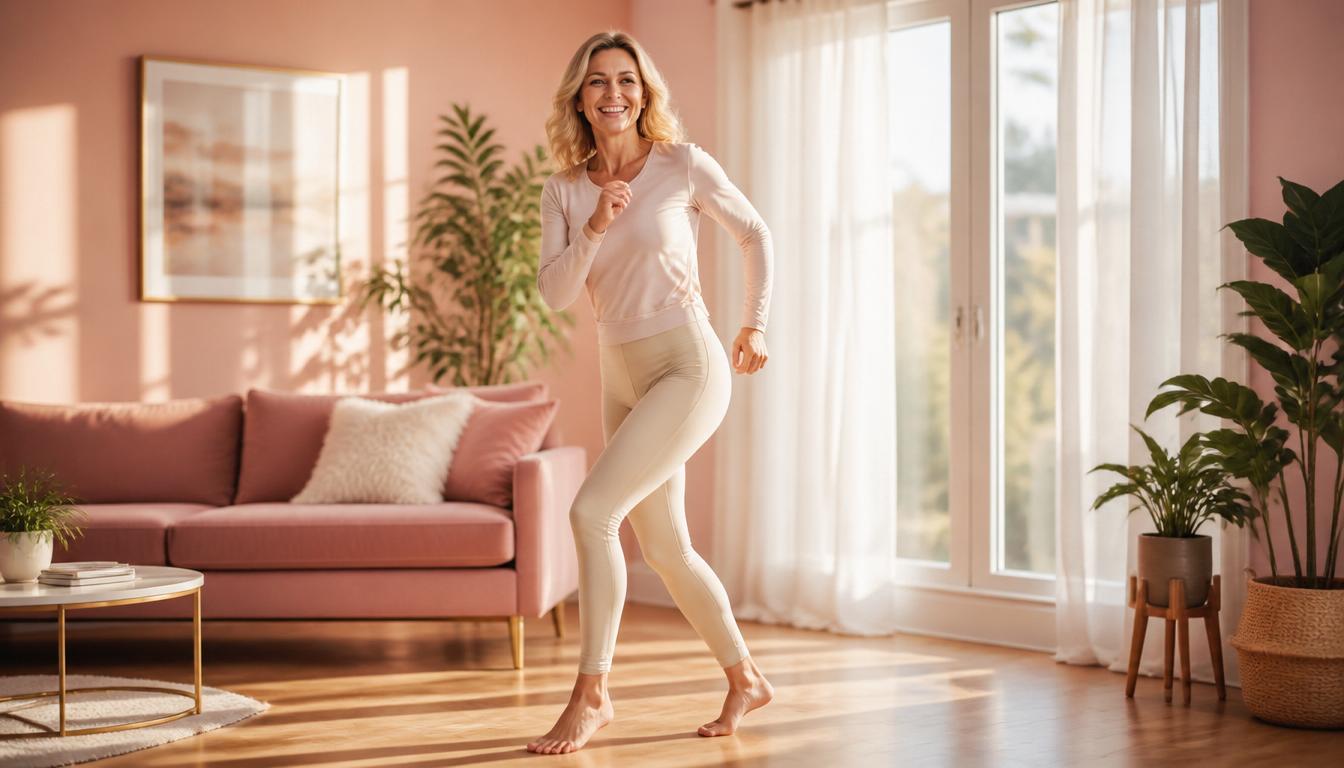
You're in your 40s, your knees are starting to file complaints, and every cardio class on the internet still opens with burpees. Low-impact cardio for women over 40 is the answer — and done correctly, it raises your heart rate to the same zone 2 a 25-year-old gets from jogging, with a fraction of the joint load. This guide gives you the actual playbook.
The promise: you'll finish this article knowing exactly what "low impact" means, your target heart rate by decade, the seven moves that work, a 4-week ramp-up, and the three mistakes that turn a "gentle" workout into shin splints.
What you'll learn
- The medical definition of low-impact cardio (and what it is not)
- Heart-rate targets for women in their 40s, 50s and 60s
- A 4-week beginner ramp-up — frequency, duration and intensity
- Seven low-impact moves that genuinely raise your heart rate
- How dance compares to walking, cycling and swimming for joint load
What does "low-impact cardio" actually mean?
Low-impact cardio is any aerobic exercise where at least one foot stays on the ground at all times[1]. That's the entire definition. It is not the same as low-intensity — a fast Latin dance step with grounded feet is low impact but moderate-to-high intensity, while jogging at a chatty pace is high impact but low intensity. The distinction matters because the women's-health research that supports low-impact cardio is about impact forces on joints, not effort.
Ground-reaction force in jogging is roughly 2.5–3× body weight per stride[2]. In a low-impact dance step or brisk walk, it stays under 1.5×. Across 30 minutes of cardio that's the difference between ~10,000 N of cumulative knee load and ~5,000 N — a real, measurable reason your knees feel different the next morning.
Most women in their 40s don't need to do less cardio. They need to do cardio that respects how connective tissue and pelvic-floor pressure have changed since their 20s. The dose stays the same; the format changes.
— Dr. Mara Lindqvist, movement researcher, Karolinska Institute
Target heart-rate zones by decade
The WHO recommends 150–300 minutes of moderate-intensity aerobic activity per week for adults, with the same target for women through menopause and beyond[3]. What changes is the number you aim for, because max heart rate drops roughly 1 bpm per year. Use this table — but trust your breath ("can speak in short sentences, not sing") more than the watch.
| Age | Max HR (~220 − age) | Moderate zone (60–70%) | Vigorous zone (70–85%) |
|---|---|---|---|
| 40 | 180 | 108–126 | 126–153 |
| 45 | 175 | 105–123 | 123–149 |
| 50 | 170 | 102–119 | 119–145 |
| 55 | 165 | 99–116 | 116–140 |
| 60 | 160 | 96–112 | 112–136 |
The goal for most women 40+ is to live in the moderate zone for 30 minutes, 4–5 days a week. That's where the metabolic, cardiovascular and mood benefits compound without taxing recovery — which is the real constraint in perimenopause, not effort tolerance[4].
The 7 low-impact moves that raise your heart rate
Low impact does not mean low intensity. Done at tempo, these seven moves push most women into the moderate-to-vigorous zone within 90 seconds:
- Side-to-side step touches — wide stance, fast tempo
- Grapevines — adds rotation, recruits obliques
- Marching with arm pumps — biggest cardio bang per joule
- Heel digs with bicep curls — upper body raises HR fast
- Cha-cha basic — built-in 1-2-3 rhythm, beloved in Latin dance fitness
- Box step with snaps — calls for coordination, distracts you from effort
- Low Charleston — one of the few high-energy moves with zero jumping
Notice what's not on the list: jumping jacks, mountain climbers, burpees, lunges. Those are all high impact (jacks, climbers) or high knee-shear (lunges) for an unconditioned 40-something knee. Skip them for the first 8 weeks even if they look "beginner."
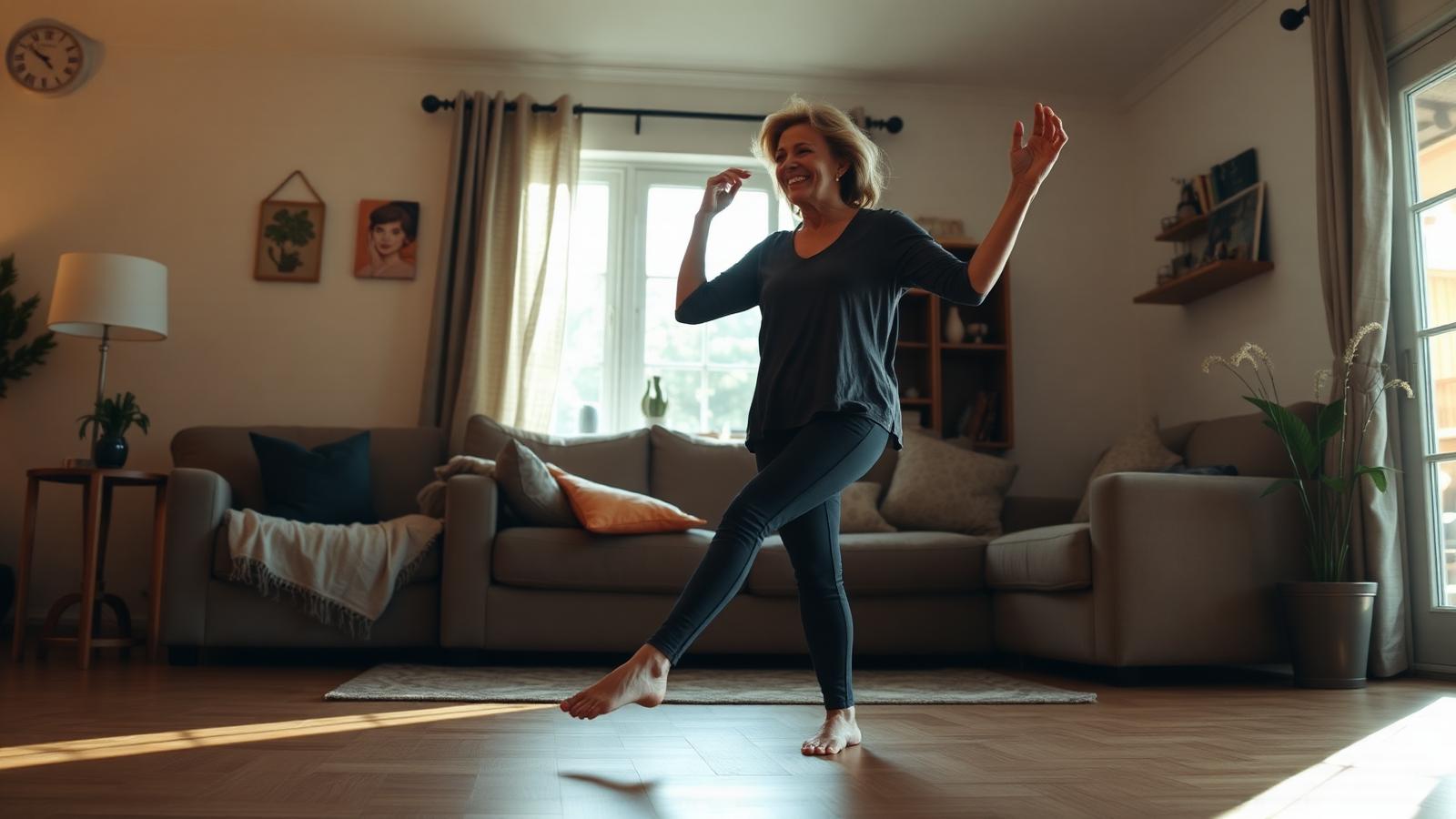
Here's exactly how those moves chain into a 12-minute low-impact dance routine — notice every foot stays grounded but the heart rate climbs:
If you can talk in short sentences but not sing along, you're in the right zone.
A 4-week ramp-up for women new to cardio
Most "start exercising again at 40" injuries happen in week 1 — too much, too fast, on tendons that haven't taken impact in years. Tendons remodel slower than muscle, especially with the estrogen dip of perimenopause[5]. The schedule below is the slowest plan that still gets you to WHO targets in 4 weeks.
| Week | Days/wk | Session length | Target zone |
|---|---|---|---|
| 1 | 3 | 15 min | Light (50–60%) — can sing |
| 2 | 4 | 20 min | Light-moderate (60–65%) |
| 3 | 4 | 25 min | Moderate (65–70%) — short sentences |
| 4 | 4–5 | 30 min | Moderate (65–75%) — WHO target |
Add one rest day between the first three sessions of each week. By week 4, you'll be hitting 100–120 minutes of moderate cardio per week — two-thirds of the WHO weekly minimum from a standing start. Pair it with one strength-focused dance day like Dance Sculpt Fusion to protect bone density, which starts declining around age 40.
How low-impact dance compares to walking, cycling and swimming
Walking is the gold standard for "anything is better than nothing," but it tops out at about 60% of max HR for most women unless you add hills. Cycling and swimming go higher but require equipment, pool access or weather. Dance is the only modality that hits all four boxes: joint-friendly, heart-rate-elevating, equipment-free, weather-proof — and it scores measurably higher than walking on mood and adherence at 12 weeks[6].
| Modality | Joint impact | Avg HR (% max) | Mental-health score | Adherence at 12 wks |
|---|---|---|---|---|
| Brisk walking | Very low | 55–65% | Medium | High |
| Stationary cycling | Very low | 65–80% | Medium | Medium |
| Lap swimming | None | 65–80% | Medium-high | Low (logistics) |
| Low-impact dance | Low | 65–80% | High | High |
That mental-health edge matters more in perimenopause than people realize — depressive symptoms peak in this window, and consistent moderate cardio is one of the few non-pharmacological interventions with effect sizes comparable to SSRIs in mild-to-moderate cases[7].
Frequently asked questions
Is low-impact cardio enough to lose weight after 40?
Yes, when paired with adequate protein and sleep. Weight loss after 40 is roughly 80% nutrition / 20% movement — but the movement is what protects lean mass and metabolic rate during a calorie deficit. Two 30-minute low-impact cardio sessions plus two strength days per week is the minimum effective dose.
Can I do low-impact cardio every day?
Yes — daily 20–30 minute sessions are well within the recovery capacity of healthy 40+ joints, which is why walking-every-day cultures have such durable cardiovascular outcomes. The injury risk only spikes when you stack high-impact load.
What about perimenopause hot flashes during cardio?
Hot flashes can intensify with rising core temperature. Train in a cooler room, hydrate before (not during) the session, and consider morning workouts when core temp is naturally lowest. Most women report fewer hot flashes overall after 8 weeks of consistent moderate cardio.
Do I need a fitness tracker?
Helpful, not required. The talk test (can speak short sentences) and the rate of perceived exertion (6/10) are remarkably accurate proxies for the 65–75% HR zone where you want to live.
Sources
- [1]ACE Fitness — Low-Impact vs High-Impact Exercise
- [2]Nilsson & Thorstensson — Ground reaction forces in walking and running
- [3]WHO — Physical activity guidelines for adults
- [4]Santoro et al. — The Menopause Transition
- [5]Chidi-Ogbolu & Baar — Estrogen and musculoskeletal performance
- [6]Fong Yan et al. — Dance interventions meta-analysis
- [7]Singh et al. — Physical activity for depression and anxiety
Put it into practice with Low-Impact Gentle Dance.
30 days of low-impact movement — no jumps, no jolts. Gentle cardio, posture work and joint mobility, short enough for a busy morning.
- 15 min daily sessions
- Low-impact modifications
- No equipment, 2 m²
- Cancel anytime
“Lost 3 kg without weighing food. I just kept pressing play because the music is that good.”

Lena is a doctor of physical therapy (DPT) who has spent 12 years working with adults 60+ on balance, arthritis recovery, and a confident return to movement after injury. She designs Everdance's chair and low-impact programs and writes everything we publish about ageing well.

Helena has spent two decades editing health journalism for European magazines. She fact-checks every Everdance article against primary sources.
Keep reading
All articles →
Is Dancing Good Exercise? What the Research Says
How Many Calories Does Dancing Burn? (by Style, 30 and 60 Minutes)