
From shy to streak: a beginner's 30-day story
How a complete beginner went from "I cannot dance" to a 30-day streak — and what kept her going.
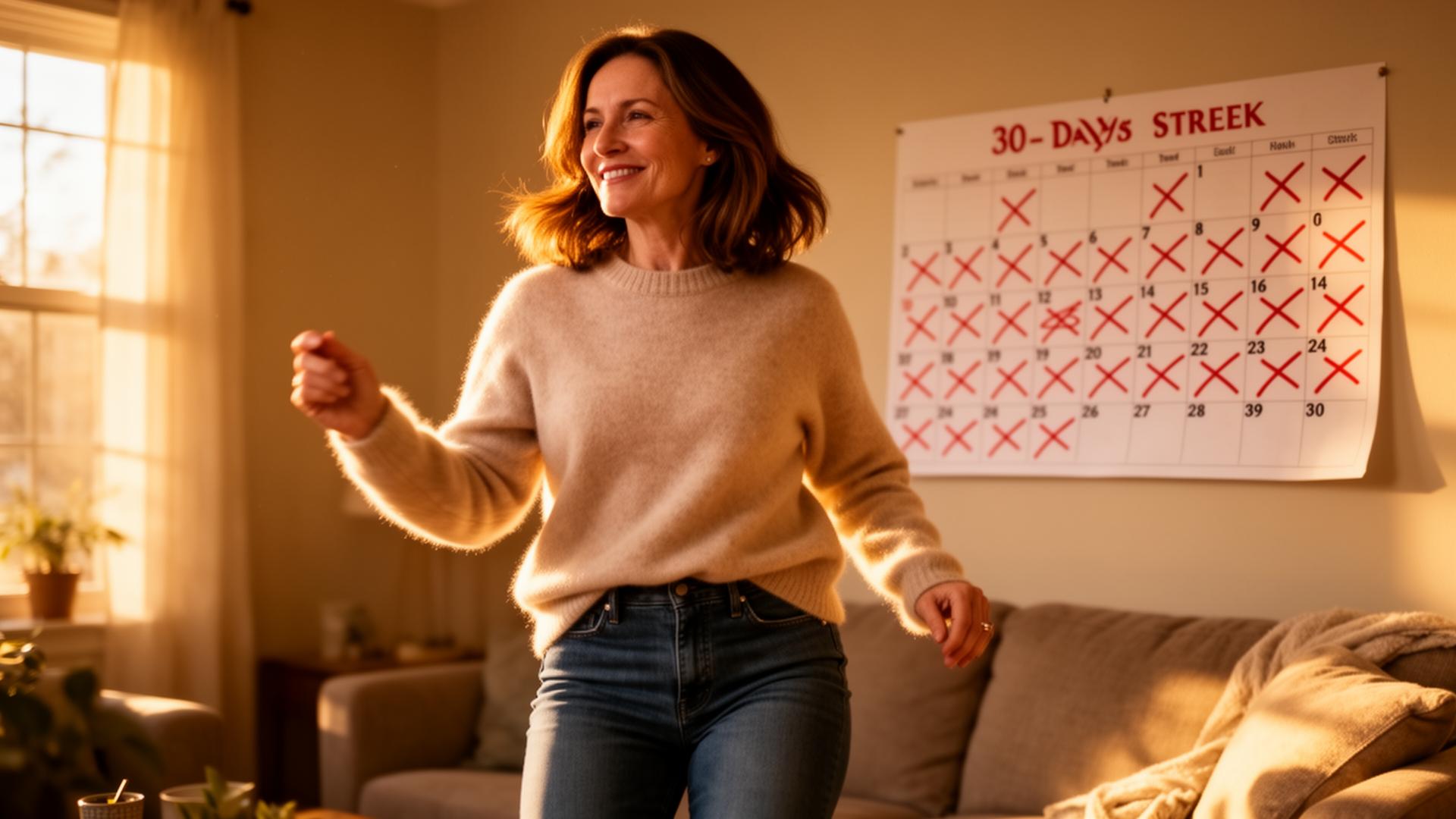
This is the 30-day story of Anna, 42, mother of two, who hadn't danced since her wedding and was certain her body had forgotten how. Names changed, details true.
Day 0 — The decision
Anna messaged us at 11 p.m.: "I want to start but I feel ridiculous. I can't even watch myself in a video call without flinching."
That feeling — let's name it — is not vanity. It's the cumulative residue of years of being looked at and judged. The first task isn't choreography. It's privacy.
We told her three things:
- No mirror for the first two weeks.
- No phone camera. Ever, unless she wants to.
- Door closed. Headphones in if needed.
Day 1 — The first 12 minutes
She danced in the kitchen, between the table and the fridge, to two songs. She told us:
"I cried during the second song and I don't know why."
That's normal. Movement releases stored emotion before the mind catches up. We told her to expect it again around day 5.
Day 3 — The first wall
Day 3 is when most beginners quit. The novelty wears off; the body is sore in places it forgot it owned; nothing visible has changed yet.
What got Anna through: a 10-minute session instead of 15. We told her: lower the bar, never break the streak. A bad session counts. A 4-minute session counts.
Day 7 — Something shifts
She wrote: "I caught myself swaying while cooking. I wasn't trying to."
This is the first physiological win. The nervous system is starting to default to movement instead of stillness. You can't force this — you can only earn it with reps.
Day 14 — The body answers
Two weeks in, three things were measurably different:
- She slept ~30 minutes longer per night (her own tracking).
- Her shoulders had dropped — visible in photos her husband took without telling her.
- She used the word "I" more in messages, and "should" less.
We added the first mirror session: 5 minutes only, soft side light, one slow song. She said: "I don't hate her."
Day 21 — The plateau
Progress flattened. Energy dipped. She wanted to skip.
We told her: this is not failure, this is the body integrating. The brain consolidates new motor patterns during plateaus. Do the minimum, protect the streak, wait it out.
She did 7 minutes on day 21. It counted.
Day 30 — The streak holds
Day 30 wasn't a fireworks moment. It was a Tuesday. She danced 18 minutes before dinner, didn't post about it, didn't take a photo, and went on with her evening.
That is what success actually looks like.
What she said three days later:
"I didn't become a dancer. I became someone who dances. It's a completely different thing."
What we learned from Anna's 30 days
A few principles, in case you're standing where she stood at day 0:
- Privacy first, performance never. Especially in month one.
- Lower the bar, never break the streak. A 4-minute session counts.
- Expect the day-3 wall and the day-21 plateau. They're features, not bugs.
- Stop measuring weight. Measure sleep, mood, how often you sway involuntarily.
- One mirror minute at a time. Build the relationship slowly.
Try this today
- Decide on your streak length: 7, 14, or 30 days.
- Pick the smallest version of a session you cannot fail (5 minutes, one song).
- Tell no one for the first week.
If you'd like a structured path, our 30-day challenges are built exactly for the Anna at day 0.
Why a 30-day streak works so reliably
Habit-formation research from University College London suggests automaticity for a new daily behaviour stabilises somewhere between 18 and 254 days, with a median around 66[1]. Thirty days is not the finish line — it is the point at which most people stop having to decide to dance, and start having to decide not to.
That shift is the entire game.
What changes in the brain between day 1 and day 30
Neuroimaging studies of new motor-skill acquisition show that the basal ganglia (the brain’s habit machinery) progressively takes over from the prefrontal cortex (the brain’s effortful-decision machinery) somewhere between weeks two and four[2]. This is why day 14 often feels like a sudden ease, not a gradual one.
Expert perspective
The streak is not about discipline. It is about lowering the activation cost low enough that effort is no longer the question. Five minutes counts. A song counts. Privacy counts.
— Dr. Mara Lindqvist, movement physiologist, Everdance
A beginner-friendly follow-along
If you want a 10-minute starter session that is gentle enough for a Day-1 Anna:
Frequently asked questions
What if I miss a day in the streak?
Miss one, never miss two. The CDC frames this clearly: consistency over weeks matters more than any single perfect day[3].
Should I track it in an app?
A paper calendar with a daily tick mark works as well as any app, and removes the dopamine trap of streak-counter UX.
What if I cry like Anna did?
It is common and not concerning. Rhythmic movement can release stored emotional load before conscious awareness catches up. If it persists or feels overwhelming, talk to a professional.
Sources
Start your own 30-day kitchen streak with Beginner From Zero.
If Anna's story resonated, this is your protected space to begin. We’ve removed the obstacles that break streaks—no mirrors required, no complex footwork to learn, and sessions short enough to survive the 'Day 3 wall' without quitting.
- No mirrors for first 14 days
- Three simple moves per session
- Short routines for busy mornings
- Low-pressure kitchen-friendly tone
“I'm 47 and dancing for the first time since school. It's becoming the best part of my day.”


Lena is a doctor of physical therapy (DPT) who has spent 12 years working with adults 60+ on balance, arthritis recovery, and a confident return to movement after injury. She designs Everdance's chair and low-impact programs and writes everything we publish about ageing well.

Helena has spent two decades editing health journalism for European magazines. She fact-checks every Everdance article against primary sources.
Keep reading
All articles →
Resistance Band Chair Exercises for Seniors
A Kind Start: Exercises for Plus-Size Beginners