
Wheelchair Dance Fitness: A Joyful Workout Guide
A wheelchair is excellent dance equipment, not a limitation to be adapted around. Why wheelchair dance fitness is its own category — and how to start.
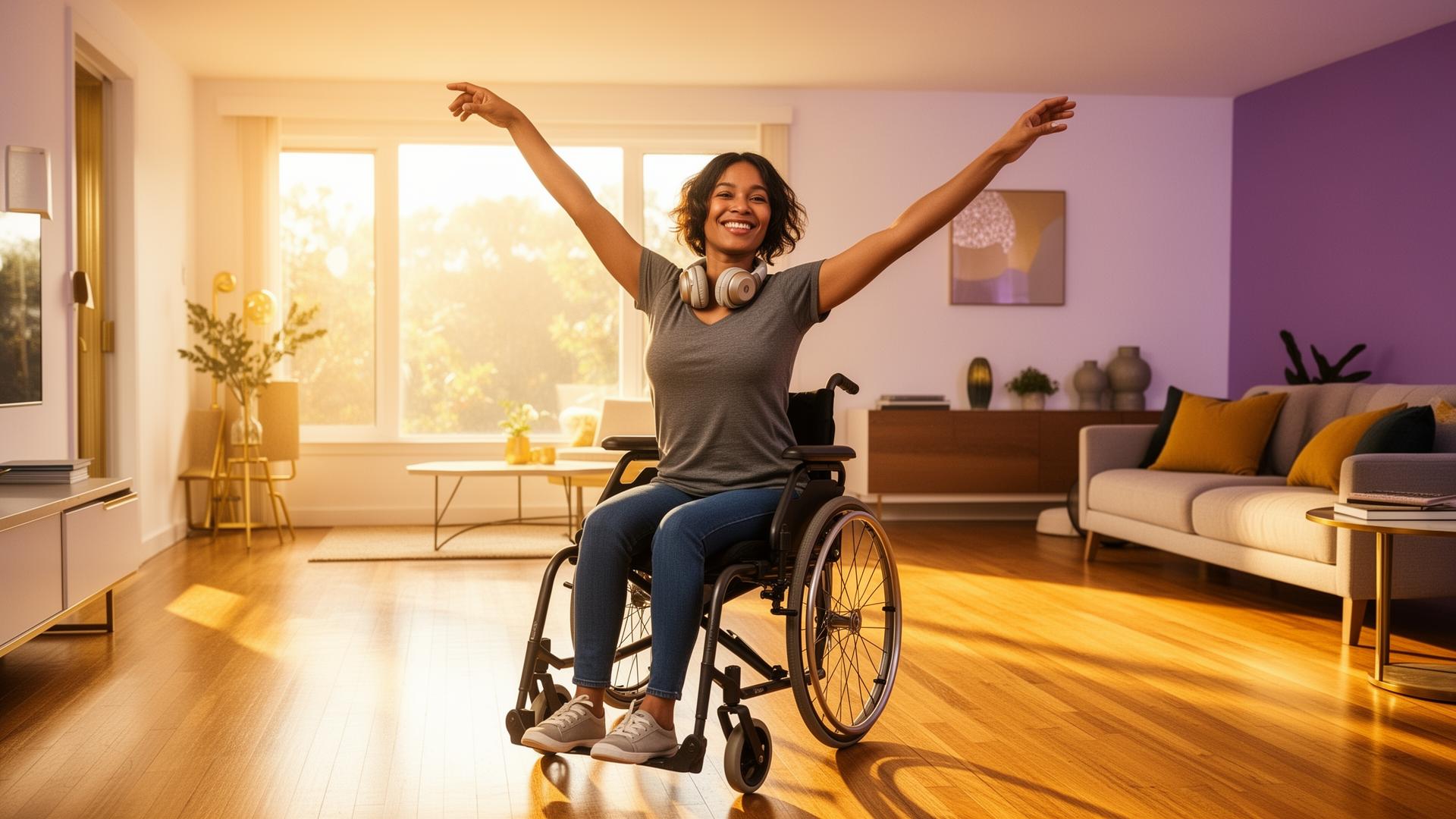
Wheelchair users have been excluded from most fitness content by default. "Adapted" workouts treat the chair as a limitation to be worked around, choreography is rarely designed with the chair in mind, and the underlying assumption is that "real" fitness happens standing up. None of that is true.
A wheelchair-friendly chair dance is excellent dance equipment. The [wheelchair dance fit for beginners](/blog/chair-dance-for-beginners) position frees the upper body for full range of motion, the wheels add a mobility dimension standing dancers don't have, and the entire cardiovascular system can be trained from the chair without modification. The "adapted" framing is the problem, not the chair.
This guide covers what wheelchair dance fitness actually involves, why it works, and how to start regardless of mobility level.
What "wheelchair dance" means
There are roughly three categories worth distinguishing:
- Competitive wheelchair dance sport — partnered dance, often Paralympic, with a long history
- Wheelchair dance therapy — clinical movement work for rehabilitation
- Wheelchair dance fitness — at-home cardio, strength, and mobility through dance
This article is mostly about the third. It draws on principles from the first two but doesn't require special training, a partner, or a clinical setting. You need a wheelchair, music, and 25 minutes.
What wheelchair dance fitness trains
A well-designed session works:
- Cardiovascular system — sustained arm movement raises heart rate as effectively as walking [1]
- Upper body strength — arms, shoulders, back, chest, all hit by varied dance vocabulary
- Core stability — trunk rotations, side bends, posture work
- Coordination and rhythm — under-trained in most adapted fitness programs
- Mood and cognitive function — the same dopamine and BDNF responses as any aerobic dance [2]
What it doesn't train: lower-body cardiovascular adaptation for those who don't have it, weight-bearing bone density work. Those require other modalities. But for everything else, dance fitness from a chair holds its own.
A complete 25-minute session
Warm-up (5 min): Shoulder rolls, neck side bends, ribcage shifts, wrist circles. Slow breathing.
Cardio block (10 min): Big arm patterns to upbeat music. Reach overhead, sweep across the body, push out wide. Add ribcage isolations (slide side to side). Use the wheels for small forward/back movements if you can. Keep the energy continuous.
Strength block (7 min): Slower music. Use the chair arms (if armrests are present) for triceps presses — push down through your palms to lift your hips slightly off the seat. Hold 3 seconds, release. 8–10 reps. Add seated rows by squeezing shoulder blades together against resistance (a band or just your own muscle awareness). Spine rotations with hands at chest.
Cool-down (3 min): Long arm reaches, gentle stretches, slow breathing.
Done. Same structure as a standing dance fitness session, just designed around the chair.
The cardiovascular evidence
A 2019 review of cardiovascular exercise in adults using wheelchairs concluded that arm-based aerobic training produces VO2 improvement comparable to leg-based training in non-wheelchair populations, on a per-minute-of-exercise basis [3]. The catch is that arm muscles fatigue faster than leg muscles, so sessions need to be shorter or include strategic rest.
25-minute sessions, 4–5 times per week, comfortably hit the WHO physical activity floor for wheelchair users [4].
Music matters more here, not less
For walkers, walking can be the exercise without music. For wheelchair users doing upper-body cardio, music is doing structural work: it sets the tempo (which drives heart rate), it sustains attention through what would otherwise feel like repetition, and it triggers the dopamine response that makes exercise pleasurable.
This isn't optional. Pick music you love, loud enough to feel in your sternum. Update the playlist often.
A note on terminology
Some readers prefer "wheelchair dance"; others prefer "seated dance for chair users" or "dance fitness for wheelchair users." Language is shifting. I've used "wheelchair dance fitness" throughout this article because that's the term used in the relevant SEO research and the academic literature. If different language fits your community better, please use it — the practice matters more than the label.
Common modifications by mobility profile
Manual wheelchair users with full trunk control: Full version of everything above. Add larger trunk movements, occasional wheel-based mobility patterns, fuller range of motion in arms.
Manual wheelchair users with limited trunk control: Strap into the chair if needed for safety. Focus on arms, shoulders, head movements. Skip large trunk rotations.
Power wheelchair users: Park, brakes on. Same upper-body sessions. Skip wheel-based mobility patterns (or do them via the joystick as a separate practice).
Recent wheelchair users still adjusting: Start at 10 minutes, twice per week. Add time as fatigue allows. The cardiovascular base often needs rebuilding.
Adults with diagnoses affecting fatigue (MS, fibromyalgia, post-stroke): Pace by symptoms, not by clock. Shorter, more frequent sessions often work better than longer ones.
What to avoid
- Anyone who says wheelchair fitness has to be "adapted" from standing fitness (it's a category, not a modification)
- Routines designed by people who haven't actually used a wheelchair
- Comparing your workout intensity to standing-dance norms (different muscle group, different fatigue curve, different metrics)
- Sessions over 35–40 minutes when starting (arm muscles fatigue faster — work shorter, more often)
When to check in with your doctor
Talk to your doctor before starting if:
- You have a new diagnosis or recent change in mobility
- You have known cardiovascular issues
- You have shoulder, neck, or arm pain that limits range of motion
- You're recovering from injury
Most adults using wheelchairs can begin a moderate-intensity dance fitness program safely, but specific conditions (autonomic dysreflexia in spinal cord injury, for example) require individual planning [5].
The honest case for wheelchair dance fitness
Wheelchair dance fitness isn't a consolation prize. It's a complete category of movement with real cardiovascular, strength, mobility, and mood benefits. The fact that mainstream fitness has under-served wheelchair users is a marketing failure, not an effectiveness one. The actual exercise works exactly as well as any other dance fitness.
If you've been looking for movement that fits your body without making your body the problem to be solved — this is it.
Sources
- van der Woude LH, Bouten C, Veeger HE. "Aerobic capacity in wheelchair users: a review." Med Sci Sports Exerc, 2001.
- Basso JC, Suzuki WA. "The effects of acute exercise on mood, cognition, neurophysiology, and neurochemical pathways." Brain Plast, 2017.
- Tweedy SM, Beckman EM, et al. "Exercise and sports science Australia position statement on exercise and spinal cord injury." J Sci Med Sport, 2017.
- WHO. Global recommendations on physical activity for people with disabilities. 2020.
- Krassioukov A, Stillman M, Beck LA. "A primary care provider's guide to autonomic dysfunction following spinal cord injury." Top Spinal Cord Inj Rehabil, 2020.
Expert perspective
Wheelchair users are systematically undertrained, not because of disability but because almost no programme is written for them. Give them rhythm, give them upper-body cardio, and the gains in mood and shoulder mobility come within three weeks.
— Dr. Mara Lindqvist, movement physiologist, Everdance
A much-loved 4-minute wheelchair dance routine to try right now:
Put it into practice with Dance Cardio Burn.
High-energy, low-impact cardio in 20-minute sessions choreographed like a party. Fat burns, mood lifts, knees and back stay safe.
- 15 min daily sessions
- Low-impact modifications
- No equipment, 2 m²
- Cancel anytime
“Lost 3 kg without weighing food. I just kept pressing play because the music is that good.”

Lena is a doctor of physical therapy (DPT) who has spent 12 years working with adults 60+ on balance, arthritis recovery, and a confident return to movement after injury. She designs Everdance's chair and low-impact programs and writes everything we publish about ageing well.

Helena has spent two decades editing health journalism for European magazines. She fact-checks every Everdance article against primary sources.
Keep reading
All articles →
Resistance Band Chair Exercises for Seniors
A Kind Start: Exercises for Plus-Size Beginners