
Resistance Band Chair Exercises for Seniors
The cheapest, safest, most effective strength training a senior can do at home — six exercises, one band, one chair, twenty minutes.
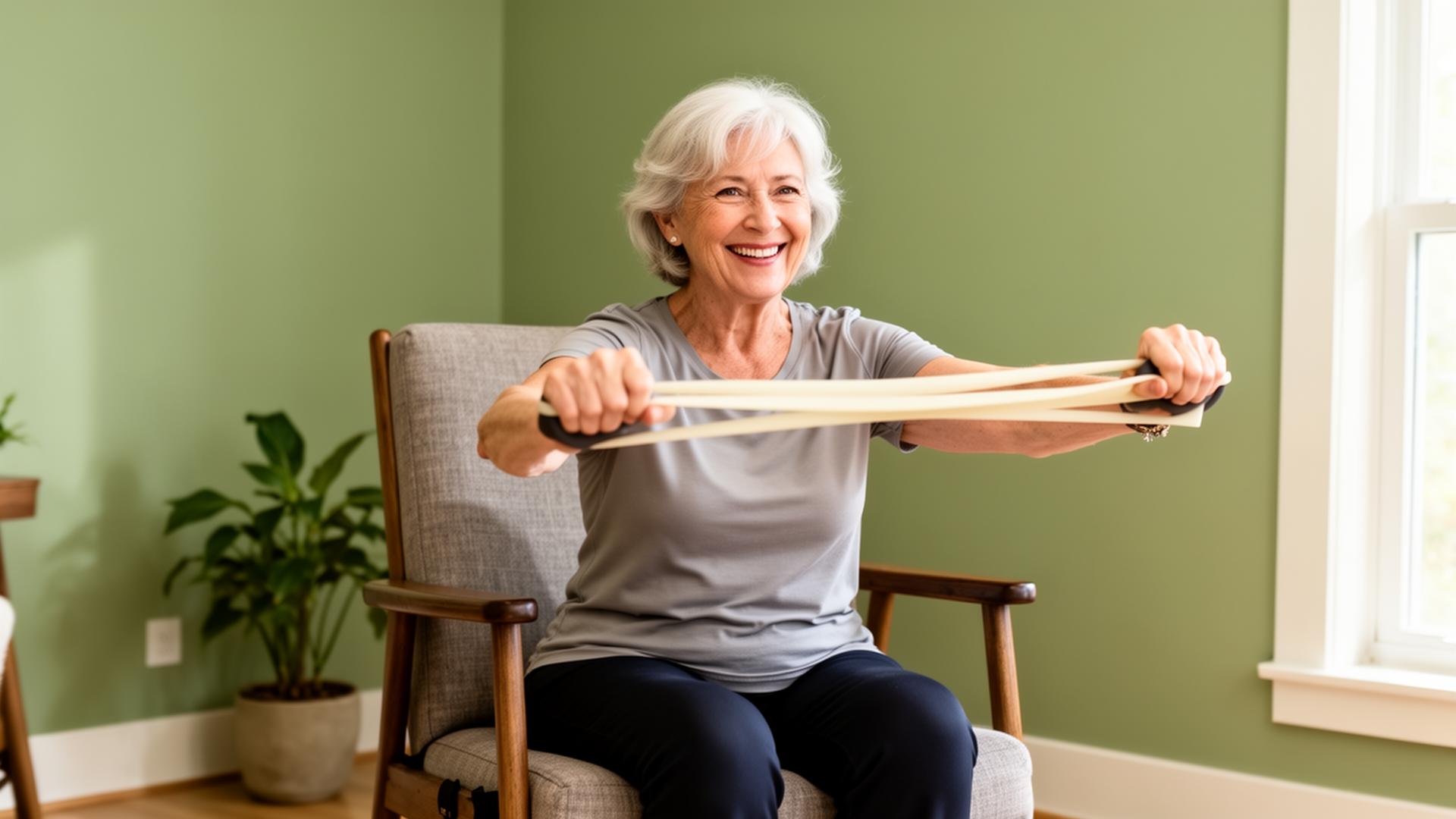
A resistance band chair dance is the cheapest, lightest, most versatile piece of strength equipment ever made. For seniors specifically, it's also the safest: there's no weight to drop, no metal to bruise against, and the resistance scales smoothly to whatever you can handle today.
When you combine resistance bands with a sturdy chair, you get a complete strength training program that fits in a drawer. This is how to use it.
Why seniors specifically need resistance training
Muscle mass declines roughly 1% per year after age 50 if no resistance training is done [1]. By 80, that's a 30% loss — directly responsible for falls, loss of independence, and difficulty with basic activities like rising from a chair.
The intervention that reverses this is well-established: progressive resistance training, twice per week, for as long as the person lives. Done consistently, even adults in their 90s build measurable muscle [2].
The problem isn't that seniors can't build muscle. The problem is that most strength training is intimidating or unsafe at home. That's where bands fix it.
Why bands beat dumbbells for most seniors
Resistance bands have several advantages over weights for older adults:
- No drop risk. A dropped dumbbell can break a foot. A dropped band lands on you harmlessly.
- Scalable resistance. Holding the band closer to the anchor point = lighter. Further = heavier. No need to buy multiple weights.
- Joint-friendly resistance curve. The hardest part of a band exercise is where the muscle is strongest, not where the joint is most vulnerable.
- Cheap and portable. A set of three bands costs $10–20. Fits in any drawer.
- No noise. Important if you live with anyone.
The disadvantage is that bands wear out — replace every 6–12 months of regular use, or whenever you see fraying.
The right band for a senior chair dance for beginners
Look for a loop band (continuous circle, no handles) in light or medium resistance. A set with multiple resistance levels lets you progress. Brands matter less than thickness; aim for ~6 inches wide.
Avoid:
- Tube bands with handles for the first few months (more complicated to use safely)
- Heavy or extra-heavy bands until you've built up
- Mini bands (too short for full-body work)
If you can find a "yoga strap"–width band, that's roughly what you want.
A complete chair + band workout for seniors
Six exercises. 30 seconds each. Two rounds. Total time: ~12 minutes plus warm-up.
Warm-up (3 min): Shoulder rolls, neck side bends, ankle circles, ribcage shifts.
1. Seated rows. Loop band around both feet. Hold ends in each hand. Pull elbows back, squeeze shoulder blades. (Targets upper back — the muscle most weakened by sitting.)
2. Chest press. Band around upper back, ends in each hand. Press forward. (Balances the rows.)
3. Bicep curls. Stand on band, hold ends. Curl up. (Front-of-arm strength.)
4. Overhead press. Same setup. Press hands overhead. (Shoulder strength for reaching.)
5. Seated leg press. Band looped around one foot, hold ends. Press foot away. Alternate. (Quad strength for standing up.)
6. Lateral band walks (seated version). Loop band around thighs above knees. Press knees apart against the band, slowly. (Hip strength for stability.)
Cool-down (2 min): Arms overhead stretch, gentle twists, deep breathing.
That's a complete strength session. Do it twice a week.
How to know you're at the right intensity
The last two reps of each exercise should be hard but doable with good form. If the band is so light you could do 50 more, it's too easy — move closer to the anchor or get a heavier band. If you can't get to 8 reps with good form, it's too heavy — move further from the anchor or use a lighter band.
This is called "rep range to failure" and it's the most robust principle in strength training research [3]. Light bands taken to near-failure produce roughly the same hypertrophy as heavy weights taken to near-failure, in any population studied [4].
What "two times a week" actually does
After 8 weeks of twice-weekly resistance band training, older adults reliably show:
- 15–25% improvement in upper-body strength [5]
- 10–20% improvement in lower-body strength
- Measurable improvement in chair-rise speed (the standardized test most predictive of independent living)
- Better posture (because the rows chair dance with resistance bands the chest)
The benefits plateau if you stop and resume the lost strength within 2–3 weeks of detraining. Consistency wins.
Common mistakes with bands
- Going too fast. Tempo matters. Three seconds up, one-second hold, three seconds down. Slow tempo = more time under tension = more strength gain.
- Holding breath. Exhale on the work, inhale on the return. Holding spikes blood pressure.
- Letting the band snap back. Always control the return. The eccentric (returning) phase is where 60% of the gain happens.
- Sticking with too-light bands forever. Progress. Move closer to the anchor, switch to medium, eventually to heavy. Your strength will keep increasing.
Adding music makes it a dance
This is the everdance angle. The same six exercises, set to music with rhythm cues, stop feeling like calisthenics. Tempo controls your rep speed. Choreographed transitions string the moves into a flow. Twenty minutes disappears.
Our Chair Dance with Resistance Bands program is built around this principle: real strength work, real rep ranges, real progression — set to music that makes the work invisible.
When to skip band work
Skip a strength session if you have:
- Acute joint pain (not just stiffness)
- Recent injury you haven't had checked
- A fever or active illness
Modify (don't skip) if you have:
- Chronic shoulder issues — keep band work below shoulder height
- Wrist arthritis — use a band-with-handles to reduce grip demand
- High blood pressure — emphasize the exhale, don't hold breath
The simple version
Two times per week. Six exercises. One band. One chair. Twenty minutes.
That's enough to reverse age-related muscle loss in most people over 60. The protocol works because it's so achievable people actually do it.
Sources
- Janssen I, Heymsfield SB, et al. "Skeletal muscle mass and distribution in 468 men and women aged 18–88 yr." J Appl Physiol, 2000.
- Fiatarone MA, Marks EC, et al. "High-intensity strength training in nonagenarians." JAMA, 1990.
- Schoenfeld BJ, Grgic J, et al. "Resistance training volume enhances muscle hypertrophy but not strength in trained men." Med Sci Sports Exerc, 2019.
- Schoenfeld BJ, Grgic J, Krieger J. "How many times per week should a muscle be trained to maximize muscle hypertrophy? A systematic review and meta-analysis." J Sports Sci, 2019.
- Martins WR, de Oliveira RJ, et al. "Elastic resistance training to increase muscle strength in elderly: a systematic review with meta-analysis." Arch Gerontol Geriatr, 2013.
Expert perspective
Bands are the most underrated tool for older adults. They give you progressive resistance without the eccentric joint stress of dumbbells, and you can travel with the whole gym in a coat pocket.
— Dr. Mara Lindqvist, movement physiologist, Everdance
A short seated strength follow-along that pairs well with bands:
Put it into practice with Dance Cardio Burn.
High-energy, low-impact cardio in 20-minute sessions choreographed like a party. Fat burns, mood lifts, knees and back stay safe.
- 15 min daily sessions
- Low-impact modifications
- No equipment, 2 m²
- Cancel anytime

“Lost 3 kg without weighing food. I just kept pressing play because the music is that good.”

Lena is a doctor of physical therapy (DPT) who has spent 12 years working with adults 60+ on balance, arthritis recovery, and a confident return to movement after injury. She designs Everdance's chair and low-impact programs and writes everything we publish about ageing well.

Helena has spent two decades editing health journalism for European magazines. She fact-checks every Everdance article against primary sources.
Keep reading
All articles →
A Kind Start: Exercises for Plus-Size Beginners
Wheelchair Dance Fitness: A Joyful Workout Guide