

1200-Calorie Meal Plan for Dance Workouts: An Honest Guide (Read First)
Considering a 1200-calorie meal plan with dance workouts? Read this honest guide first — what the number actually means, why it backfires for most women, and the safer plan that still loses fat.

Most women searching for a "1200-calorie meal plan for dance workouts" want a fast, predictable way to lose weight. The honest answer: for almost any woman dancing 4+ days/week, 1200 kcal/day is below your floor, not your finish line. Below, exactly why — and a 1500–1650 kcal version that loses fat without trashing your training, hormones or weekends.
Why "1200 calories + dance workouts" is the wrong starting point for most women
Resting metabolic rate (RMR) for a woman 30–55, 60–80 kg, is roughly 1300–1500 kcal/day before she does anything[1]. Add a 30-minute dance session burning 250–350 kcal, plus the energy your body needs for digestion and basic movement, and a true maintenance intake lands around 1900–2200 kcal. Eating 1200 kcal on top of that creates a deficit so steep that the body responds the same way it does to famine: appetite hormones spike, NEAT (fidgeting, walking, posture) drops, and within 2–4 weeks adaptive thermogenesis reduces what you burn at rest by 5–15%[2].
Translation: the deficit you think you have shrinks as you go. The scale moves fast in week 1 (mostly water and glycogen), stalls by week 3, and most women either binge or quit by week 6.
Where the 1200-calorie number actually came from
It is not a clinical recommendation. The "1200" figure originates in 1918 weight-loss pamphlets and was popularized by women's magazines through the 1970s–90s. Modern professional bodies — Academy of Nutrition and Dietetics, ISSN, Mayo Clinic — recommend a deficit of 300–500 kcal below maintenance, not a fixed low number[3]. For a woman doing 4–5 dance workouts a week that almost always lands at 1500–1750 kcal/day.
| What you'll often read | What evidence actually supports |
|---|---|
| "1200 kcal is the standard female diet" | No professional body recommends a fixed 1200 kcal |
| "Lower calories = faster results" | Faster initial scale loss, slower body-comp change, higher dropout[2] |
| "Exercise on top of 1200 burns more fat" | Combined low food + high training accelerates muscle loss, not fat loss |
| "If you're not losing, eat less" | Often: eat enough to recover, train harder, sleep more |
What a 1200-calorie day really looks like when you're dancing
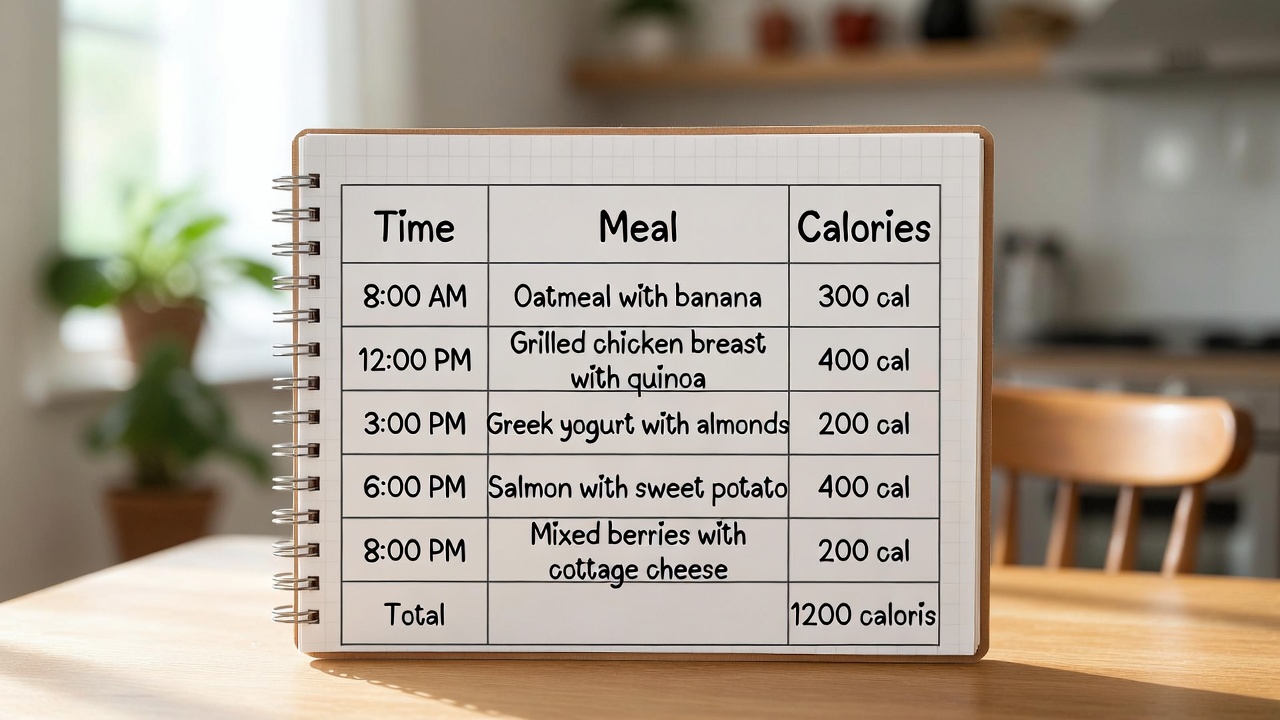
Day in numbers (a real example readers send us):
- 7:30 — coffee + 1 slice toast + 1 tsp peanut butter (180 kcal, 5 g protein)
- 12:00 — large salad with 80 g chicken, dressing (320 kcal, 24 g protein)
- 16:00 — apple + 10 almonds (160 kcal, 3 g protein)
- 17:30 — 45-minute dance class (burns ~350 kcal)
- 19:30 — 100 g salmon, ½ cup rice, vegetables (440 kcal, 28 g protein)
- 21:00 — herbal tea, hunger
Total in: 1100 kcal, ~60 g protein. Net after class: ~750 kcal. That is not "moderate restriction." That is acute energy deficiency relative to training load. Within 7–10 days of this pattern, most women report dizziness in class, disturbed sleep, and the late-evening binge that "ruins" the diet — which is not weakness; it's biology.
When I see a client eating under 1300 kcal and training 5 days a week, the conversation isn't "how do we cut more." It's "how do we eat enough that your body lets you keep training."
— Dr. Mara Lindqvist, movement researcher
The hidden costs your tracker doesn't show
Calorie apps measure calories. They don't measure:
- Loss of lean muscle. In a steep deficit without adequate protein, 25–35% of weight lost is muscle[1]. Less muscle = lower resting burn = easier regain.
- Menstrual cycle disruption. Chronic energy deficiency is the most common cause of secondary amenorrhea in active women[2]. Cycle changes often precede the scale plateau.
- Sleep degradation. Going to bed under-fed raises overnight cortisol and disrupts REM sleep, which then raises next-day hunger.
- Training quality collapse. Dance workouts feel "harder" not because you're unfit but because your glycogen stores are chronically low.
- Food noise. Constant intrusive thoughts about food — a documented side effect of restriction, not a personality flaw.
This is the part the "before/after" Instagram posts never include.
Here is a board-certified RD walking through why extreme calorie cuts backfire — worth the 2 minutes before you commit to 1200.
The safer alternative: a 1500–1650 kcal plan that still loses fat
For a woman 30–55, 60–80 kg, dancing 4–5 times/week, a steady 1500–1650 kcal/day with ~110 g protein produces 0.4–0.6 kg/week of fat loss — without the side effects above[1]. That's 1.6–2.4 kg/month. Slower than crash diets in week 2, faster than crash diets by month 4, because you're still training.
Macro split:
| Macro | Grams/day | % of intake |
|---|---|---|
| Protein | 100–110 g | ~28% |
| Carbs | 170–190 g | ~45% |
| Fat | 45–55 g | ~27% |
Protein at this level protects muscle in the deficit. Carbs at this level let you finish a 30-minute dance class without the wall. Fat keeps satiety stable so you're not starving by 8 pm.
For the full 7-day version of this safer plan, see the 7-day meal plan for dance workouts.
A 3-day sample (~1550 kcal) for an active dancer
Day 1 — Breakfast: Greek yogurt parfait (200 g 2% Greek yogurt, ½ cup oats, 1 cup berries, 10 g almonds; 410 kcal, 28 g protein). Lunch: chicken & quinoa bowl (120 g chicken, ¾ cup quinoa, 1 cup roasted vegetables, vinaigrette; 540 kcal, 38 g protein). Pre-class: banana + 1 tbsp peanut butter (210 kcal). Dinner: 130 g salmon, medium sweet potato, 1.5 cups broccoli (450 kcal). Total ~1610 kcal, ~108 g protein.
Day 2 — Breakfast: 3-egg veggie omelette + 1 slice rye toast + ½ avocado (480 kcal, 24 g protein). Lunch: lentil soup + 1 small wholegrain roll (470 kcal, 22 g protein). Pre-class: apple + 100 g cottage cheese (180 kcal, 14 g protein). Dinner: turkey & vegetable stir-fry (130 g turkey, 1 cup vegetables, ¾ cup rice, sesame oil; 470 kcal, 36 g protein). Total ~1600 kcal, ~96 g protein.
Day 3 — Breakfast: overnight oats (½ cup oats, 200 ml milk, 1 scoop protein, ½ cup berries; 430 kcal, 28 g protein). Lunch: tuna salad wrap (1 can tuna, 2 tbsp Greek yogurt, celery, wholegrain wrap; 460 kcal, 32 g protein). Pre-class: small smoothie (1 banana, 200 ml milk, ¼ cup oats; 330 kcal). Dinner: baked cod (150 g), roasted potatoes, salad with olive oil (430 kcal). Total ~1650 kcal, ~108 g protein.
This is what "eat enough to dance well, deficit small enough to keep going" looks like.
Red flags: when to stop the diet and ask for help
Stop, eat at maintenance, and speak with a registered dietitian or physician if any of these appear:
- You've lost your period or it's become very irregular.
- You're dizzy, lightheaded or cold-handed most days.
- Resting heart rate has dropped >10 bpm below your baseline.
- You think about food constantly or feel out of control around food.
- You're training but performance is steadily declining for >3 weeks.
- You feel guilt or shame around eating that didn't exist before.
None of these are "push through it" signals. They're the body telling you the deficit is too steep — or that food has stopped being just food.
Frequently asked questions
Is 1200 calories ever safe for a woman doing dance workouts?
Only under direct medical supervision, typically for very small women (under 55 kg) post-surgery or with specific medical conditions. For a healthy woman dancing 4+ times/week at home, no — 1500–1700 kcal is the realistic floor for sustainable fat loss[1].
Why do I see fast weight loss on 1200 calories in the first week?
Glycogen stores hold ~3 g of water per gram of carbohydrate. Cut carbs and calories sharply and you lose 1.5–2 kg of water + glycogen in 5–7 days. None of that is fat. It returns the moment you eat normally.
How long should I stay in a calorie deficit?
Most evidence supports 8–12 week cycles, then 2–4 weeks at maintenance to restore metabolic rate and hormones before another cycle[2]. Indefinite restriction is what produces the plateau and rebound.
Will I gain weight if I move from 1200 to 1500–1650?
You may see a 1–2 kg scale jump in the first 5–10 days — glycogen and water refilling, not fat. Body composition and training capacity improve from there, and fat-loss progress restarts.
Can I just eat 1200 calories on rest days and more on dance days?
Calorie cycling works in some advanced contexts but won't fix the core problem: your weekly average is still too low. Set a steady daily target you can actually hit, and let dance days take care of themselves.
Sources
Put it into practice with Dance Cardio Burn.
High-energy, low-impact cardio in 20-minute sessions choreographed like a party. Fat burns, mood lifts, knees and back stay safe.
- 15 min daily sessions
- Low-impact modifications
- No equipment, 2 m²
- Cancel anytime

“Lost 3 kg without weighing food. I just kept pressing play because the music is that good.”

Mara studies how short bouts of rhythmic movement affect mood and cognition. She has authored over 40 peer-reviewed papers and dances daily in her kitchen.

Helena has spent two decades editing health journalism for European magazines. She fact-checks every Everdance article against primary sources.
Keep reading
All articles →
7-Day Meal Plan for Dance Workouts: Lose Weight Without Hating Food
Pre & Post Workout Snacks for Dancers: 12 Real Ideas (Women)