
A Seated Ab Workout That Actually Works
The crunch is one of the worst ab exercises ever popularized. A well-designed seated workout trains every layer of the core — in 12 minutes, without leaving your chair.
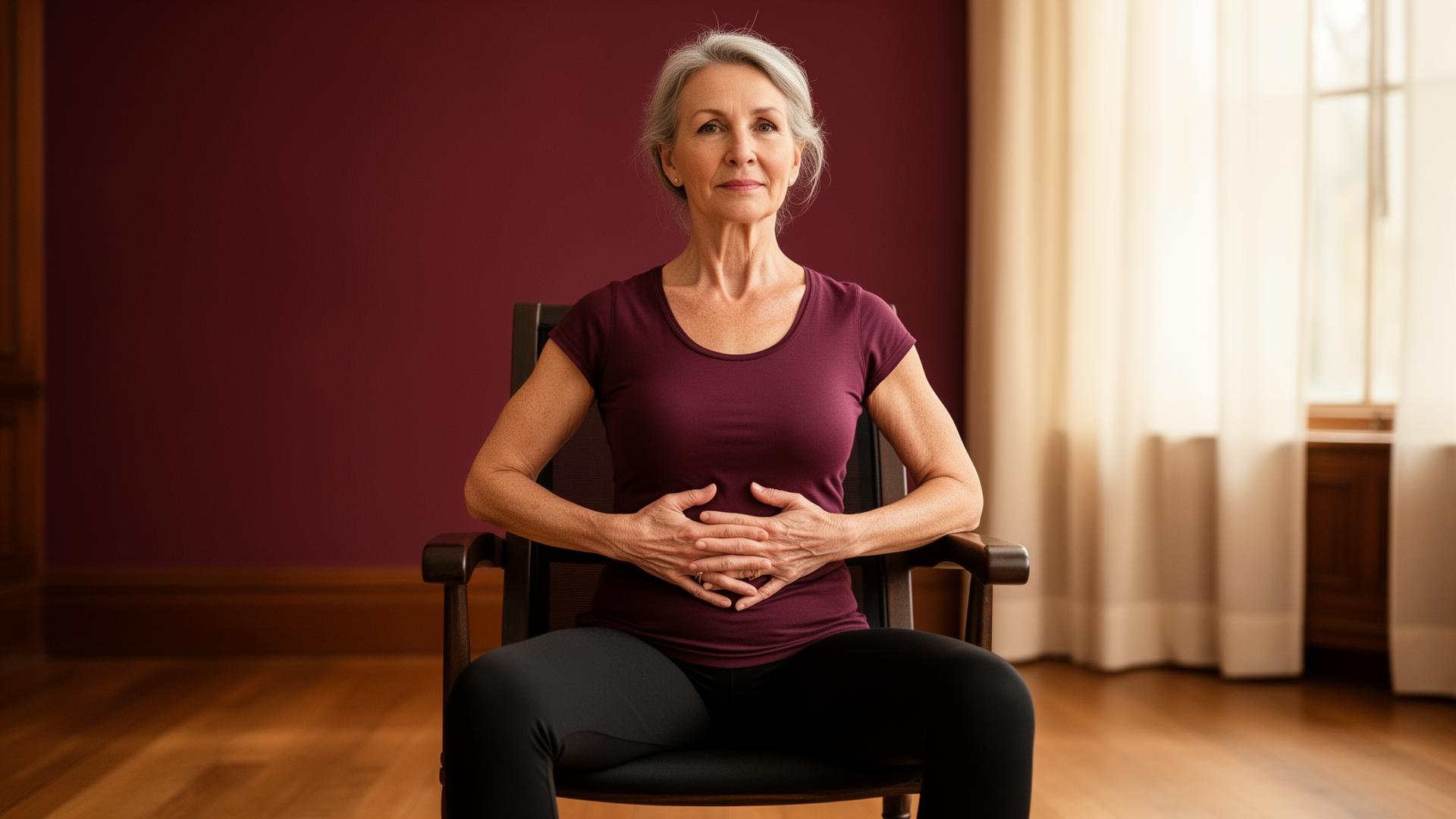
The crunch is the most-recommended ab exercise of the last 50 years and one of the worst ones. It trains a small portion of the rectus abdominis, ignores most of the core, aggravates the necks of nearly everyone who does it wrong, and produces almost no functional improvement in the activities that matter — standing up from chairs, lifting groceries, walking stairs.
A well-designed seated chair dance programs ab workout outperforms the crunch in every metric that matters, and it can be done by anyone in a sturdy chair without floor work. This is what it looks like.
What the "core" actually is
The core isn't the six-pack. The six-pack (rectus abdominis) is one of about a dozen muscles that wrap your trunk, and it's mostly there to flex the spine forward — a motion you rarely do in real life.
The functional core includes:
- Transverse abdominis — the deepest layer, like a corset, responsible for spinal stability
- Internal and external obliques — the side abs that handle rotation
- Multifidus — small muscles along the spine that fine-tune posture
- Pelvic floor — the bottom of the core, often weakened by aging and childbirth
- Diaphragm — the breathing muscle, also a core muscle
- Rectus abdominis — the front sheet, the famous one, mostly cosmetic
A serious ab workout trains all of these. The crunch trains only the last one. This is why a 6-pack doesn't necessarily translate to a strong back, good posture, or a flat-looking belly [1].
Why seated ab work outperforms floor work for most adults
Floor-based ab work (crunches, sit-ups, planks) assumes:
- You can get to the floor easily
- You can get up from the floor easily
- Your neck won't strain holding your head up
- Your lower back tolerates the spinal flexion
For most adults over 50, at least one of those breaks down. The result: they stop doing core work entirely.
Seated core work avoids all four issues. You sit. You stay sitting. You train every muscle the floor work would have trained, plus several it would have missed.
A complete seated ab workout
Total time: 12 minutes. Do this 3 times per week.
Warm-up (2 min): Spine wave (slowly arch and round your back), shoulder rolls, gentle trunk rotations.
1. Seated marches with twist (60 sec). Lift one knee while rotating the opposite elbow toward it. Alternate. Targets obliques and transverse abdominis.
2. Rib slides (60 sec). Keep hips still. Slide your ribcage left, center, right, center. Tempo with music. Pure oblique work.
3. Heel slides with breath (60 sec). Extend one leg slowly while exhaling and drawing your belly button toward your spine. Alternate. Targets transverse abdominis and pelvic floor.
4. Seated bicycle (60 sec). Hands behind head, lift one knee while rotating the opposite shoulder toward it. Alternate slowly. Obliques.
5. Ab pulses to music (60 sec). Small, fast contractions of the lower abs in time with a beat. Like miniature crunches, but isometric and pelvic-floor-engaged. Doesn't hurt the neck.
6. Side bends (60 sec). Reach one arm overhead, lean opposite direction, return. Alternate. Obliques and lateral chain.
7. Spine spirals (60 sec). Slow, controlled trunk rotation while seated upright. Deep core stabilizers.
8. Posture hold (60 sec). Sit tall, draw shoulders down, engage deep abs gently. Breathe for 60 full seconds while holding the position. Trains endurance of the postural muscles.
Cool-down (2 min): Forward fold (head toward knees if comfortable), spine twists, deep belly breaths.
That's a complete seated ab workout. It hits every layer of the core.
What this workout produces in 8 weeks
In published trials of seated core programs done 2–3 times per week for 8 weeks, participants reliably show [2]:
- Improved trunk endurance (measured by isometric hold tests)
- Better posture (measured by photographic analysis)
- Reduced lower back pain (in those who had it)
- Improved performance on the chair-rise test
- Subjective reports of a "tighter" feeling around the waist
What you generally won't see in 8 weeks: dramatic visual changes to your stomach. Visible abs require very low body fat (typically 15–20% for women, 10–15% for men) which most people aren't carrying. Stronger doesn't always mean visually different.
Combining seated abs with chair dance for belly fat work
If your goal is reduced belly size rather than just core strength, this seated ab workout should be paired with:
- Daily moderate cardio (chair exercises for belly fat counts) — 150+ minutes per week total
- Twice-weekly resistance training for the whole body — abs in isolation don't burn enough calories to matter for fat loss
- Sleep and protein — both move the needle on body composition more than any single exercise
The combined program looks like the one in our chair exercises for belly fat after 60 article. This seated ab workout is one of three weekly core-focused sessions in that program.
The most-skipped exercise that matters most
Number 8 — the posture hold — is the one most people skip because it doesn't feel like exercise. It is. Sixty seconds of consciously holding good posture trains the deep stabilizers far more than a hundred crunches. Most people can barely make it to 30 seconds the first week. By week 6, the full minute feels easy and they sit straighter throughout the day without thinking.
This is the exercise that visibly changes how you carry yourself. Don't skip it.
What to avoid
- Sit-ups (worse than crunches for the back and neck)
- Holding your breath during ab work (spikes blood pressure)
- Sucking in your stomach as your only ab work (trains the wrong muscle group)
- Any exercise that makes your lower back hurt — that's a signal to back off, not push through
When to see a doctor first
Get medical clearance before starting if you have:
- A diagnosed hernia
- Recent abdominal surgery
- Pregnancy or recent postpartum (different routine needed — diastasis recti checks matter)
- Severe lower back pain
- A pelvic floor diagnosis (incontinence, prolapse) — see a pelvic PT first
None of these necessarily rule out seated ab work, but the entry point should be supervised.
The summary
Eight exercises. Twelve minutes. Three times per week. Eight weeks.
This is a more effective ab workout than most gym-based core programs, and you don't need a gym, a mat, or to leave your chair. The reason it works is that it trains the actual core muscles in the patterns they actually use. The crunch trains one of them in a pattern almost nobody uses.
The chair did the work. Now your core can too.
Sources
- McGill SM, McDermott A, Fenwick CM. "Comparison of different strongman events: trunk muscle activation and lumbar spine motion, load, and stiffness." J Strength Cond Res, 2009.
- Park SK, Park JH, et al. "Effects of a 12-week chair-based core exercise program in postmenopausal women." J Phys Ther Sci, 2021.
Expert perspective
A trained core is what makes the difference between catching yourself on a kerb and ending up in A&E. You do not need crunches on the floor — seated rotation and anti-extension work loads the same deep muscles with a fraction of the joint stress.
— Dr. Mara Lindqvist, movement physiologist, Everdance
A short follow-along that hits the same core muscles we covered above:
Put it into practice with Dance Cardio Burn.
High-energy, low-impact cardio in 20-minute sessions choreographed like a party. Fat burns, mood lifts, knees and back stay safe.
- 15 min daily sessions
- Low-impact modifications
- No equipment, 2 m²
- Cancel anytime
“Lost 3 kg without weighing food. I just kept pressing play because the music is that good.”

Mara studies how short bouts of rhythmic movement affect mood and cognition. She has authored over 40 peer-reviewed papers and dances daily in her kitchen.

Helena has spent two decades editing health journalism for European magazines. She fact-checks every Everdance article against primary sources.
Keep reading
All articles →
Is Dancing Good Exercise? What the Research Says
How Many Calories Does Dancing Burn? (by Style, 30 and 60 Minutes)