
Chair Yoga vs Chair Dance: Which Is Right for You?
Both happen in a chair. Both are gentle. They're not the same practice — and what your nervous system needs decides which one to start with.
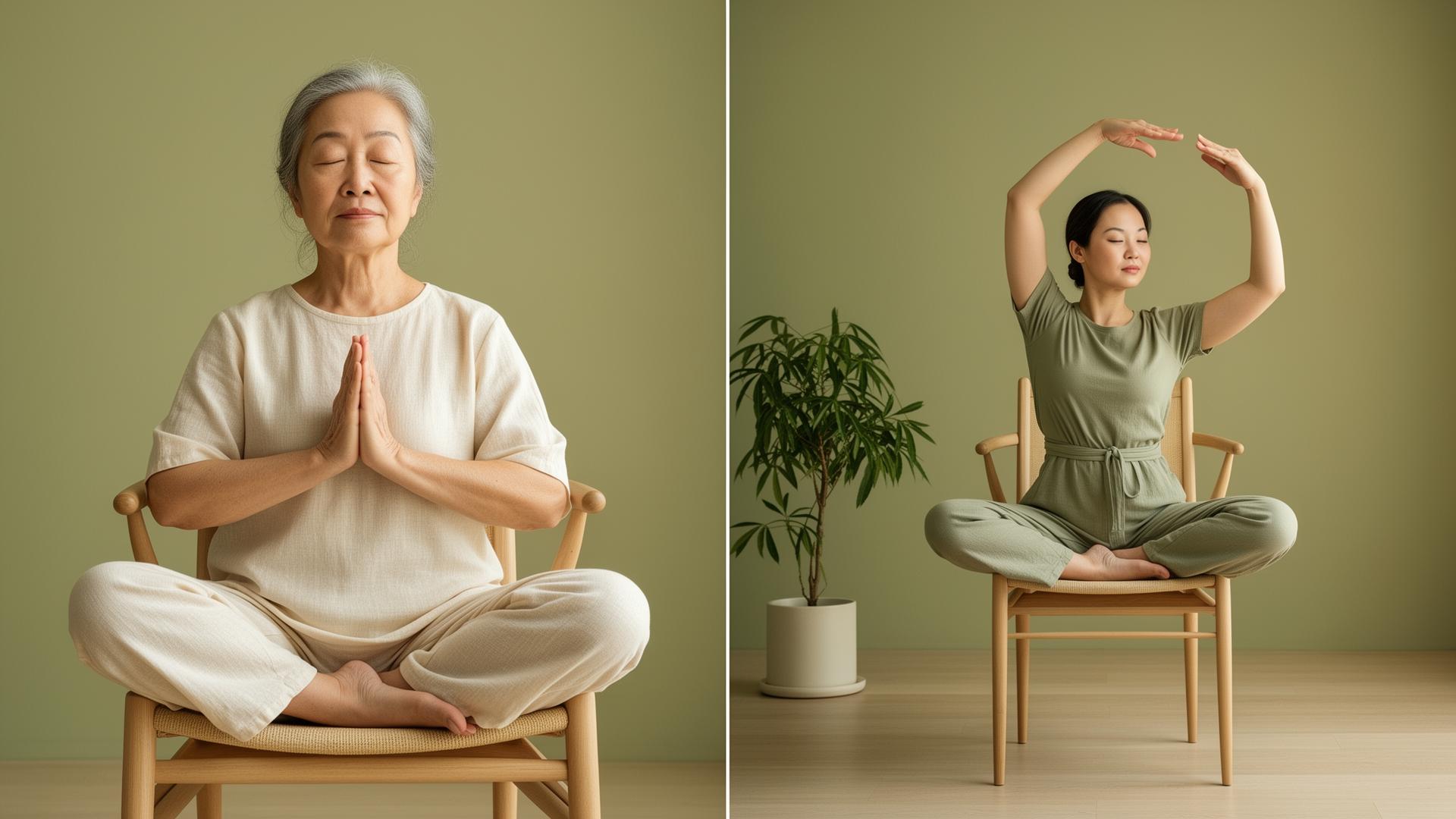
Chair yoga and chair dance look similar from a distance — both happen in a chair, both move every part of the body, both are gentle. From the inside, they're completely different experiences. One asks you to slow down, breathe, and notice. The other asks you to wake up, smile, and groove.
Which one is right for you depends on what your nervous system actually needs. This is how to choose.
What chair yoga dance flow is, exactly
Chair yoga adapts traditional yoga poses to a chair dance for beginners position, with the chair as your mat. The pace is slow. The breath leads everything. The vocabulary is internal — feel the breath, soften the shoulders, lengthen the spine.
A typical chair yoga session includes:
- Centering breathwork (3–5 minutes)
- Joint mobility — neck, shoulders, wrists, ankles
- Seated versions of classic poses — chair Warrior, chair Pigeon, chair Twist
- Optional standing-at-the-chair work
- Closing meditation or relaxation
The goal isn't fitness — it's nervous-system regulation. You leave calmer than you arrived.
What chair dance is, exactly
Chair dance uses dance choreography executed from a chair. The pace varies but is generally faster. Music leads everything. The vocabulary is external — follow the beat, hit the accents, smile.
A typical chair dance session includes:
- Brief warm-up to the first song
- Choreographed sequences across 4–6 songs
- Cardio peaks via tempo and arm patterns
- Optional core, leg, and posture accents
- Cool-down to a slower song
The goal IS fitness — mood, cardiovascular, and coordination — and the side effect is joy. You leave more energized than you arrived.
The biggest difference: nervous-system effect
Yoga activates the parasympathetic nervous system (rest-and-digest). Heart rate variability goes up. Cortisol comes down. Sleep often improves [1].
Dance activates the sympathetic nervous system (active-and-alert), then drops you back down at the cool-down. Endorphins go up. Mood lifts measurably for 1–2 hours [2].
Both are healthy. They're treating different problems.
Which one for which person
If you're chronically stressed, sleeping poorly, or recovering from illness: chair yoga.
If you're flat, low-energy, low-mood, or feel disconnected from your body: chair dance.
If you have anxiety: usually yoga first, then add dance as energy returns.
If you have depression: usually dance first, then add yoga to consolidate.
If you have neither and just want to move: you'll get more cardiovascular benefit from dance and more mobility benefit from yoga. Most people end up doing both.
What the research says about each, head-to-head
A 2020 systematic review compared seated mind-body practices (chair yoga, chair Tai Chi) against seated rhythmic activities (chair dance, chair aerobics) in older adults [3]. Findings:
- Mind-body practices were better for stress, sleep, and chronic pain.
- Rhythmic activities were better for mood, cognition, and cardiovascular fitness.
- Both were similarly good for flexibility, mobility, and quality of life.
The conclusion: do both, in different doses, depending on what you need that week.
A weekly schedule combining both
| Day | Practice | Why |
|---|---|---|
| Mon | 25 min chair dance | Energy for the week |
| Tue | 20 min chair yoga | Recover from Monday |
| Wed | 25 min chair dance | Mid-week mood lift |
| Thu | 20 min chair yoga | Sleep & nervous-system reset |
| Fri | 25 min chair dance | Friday celebration |
| Sat | 30 min long dance OR long yoga | Whatever you need |
| Sun | 15 min gentle yoga | Sleep prep for the week ahead |
This pattern gives you ~75 minutes of dance (cardiovascular) and ~75 minutes of yoga (regulation) per week — roughly the WHO physical-activity floor with regulation baked in [4].
The hybrid: chair yoga dance flow
A small but growing category blends both — slow yoga-inspired movements set to gentle music with dance-style cues. The pace is meditative, but the form is choreographic.
This works particularly well for:
- People who find pure yoga "too quiet"
- People who find pure dance "too much"
- Anyone recovering from injury who wants gentle structured movement
It's a single category but worth knowing about; it can be a complete practice on its own for low-energy weeks.
Can you do them on the same day?
Yes. Dance in the morning (energizing). Yoga in the evening (winding down). Most seniors who try this combination report sleeping better than either alone [5].
Don't do dance in the hour before bed — the elevated heart rate and dopamine make sleep harder.
What you need for either
For chair yoga: A sturdy armless chair where your feet reach the floor flat. That's it. Bare feet help. A blanket on your lap if you get cold easily.
For chair dance: The same chair. Music speakers loud enough to feel. Optional: a small towel or water bottle nearby.
Neither needs a yoga mat, special clothing, or any equipment.
How to decide what to start with this week
If you're new to seated movement entirely, start with chair yoga for two weeks. It teaches you to listen to your body and notice the subtleties before the music pulls you along.
After two weeks, add a chair dance session. See how your body responds. Adjust from there.
If you already do some form of yoga or stretching: start with chair dance. You probably need the cardio more than another mobility practice.
The one rule that applies to both
Stop the second something hurts. Both practices are designed to feel pleasant. Pain is information that you've gone past where you should be today. Tomorrow your body will tell you something different.
Sources
- Cramer H, Lauche R, et al. "Yoga for stress management." Cochrane Database Syst Rev, 2017.
- Basso JC, Suzuki WA. "The effects of acute exercise on mood, cognition, neurophysiology, and neurochemical pathways." Brain Plast, 2017.
- Park J, McCaffrey R, et al. "Mind-body and rhythmic interventions in older adults: a systematic review." J Aging Phys Act, 2020.
- WHO. Physical activity guidelines for older adults. 2020.
- Stutz J, Eiholzer R, Spengler CM. "Effects of evening exercise on sleep." Sports Med, 2019.
Expert perspective
Chair yoga and chair dance are not rivals — they are two doors into the same room. Pick yoga when your nervous system needs to come down, pick dance when your mood needs to come up. Most weeks you will want both.
— Dr. Mara Lindqvist, movement physiologist, Everdance
If you want to compare the feel of seated yoga before deciding, try this 10-minute flow:
When does chair dance become therapy?
There is a meaningful difference between dance as fitness and dance as therapy. Dance/movement therapy (DMT) is a credentialed clinical practice with documented effects on depression, eating disorders, and Parkinson's. If you want the boundary spelled out — and to know when each format is the right call — see our explainer on what dance/movement therapy is.
Put it into practice with Dance Cardio Burn.
High-energy, low-impact cardio in 20-minute sessions choreographed like a party. Fat burns, mood lifts, knees and back stay safe.
- 15 min daily sessions
- Low-impact modifications
- No equipment, 2 m²
- Cancel anytime
“Lost 3 kg without weighing food. I just kept pressing play because the music is that good.”

Lena is a doctor of physical therapy (DPT) who has spent 12 years working with adults 60+ on balance, arthritis recovery, and a confident return to movement after injury. She designs Everdance's chair and low-impact programs and writes everything we publish about ageing well.

Helena has spent two decades editing health journalism for European magazines. She fact-checks every Everdance article against primary sources.
Keep reading
All articles →
Learn Strip Dance at Home: A Realistic 6-Week Plan (No Pole)
Strip Dance vs Pole Dance: Which Should You Start With at Home?