
Low-Impact Cardio for Seniors: Move Without Pounding the Joints
Low-impact cardio isn't the easy version — it's the smart version. Why it produces the same cardiovascular gains as running, and why dance leads the category for seniors.
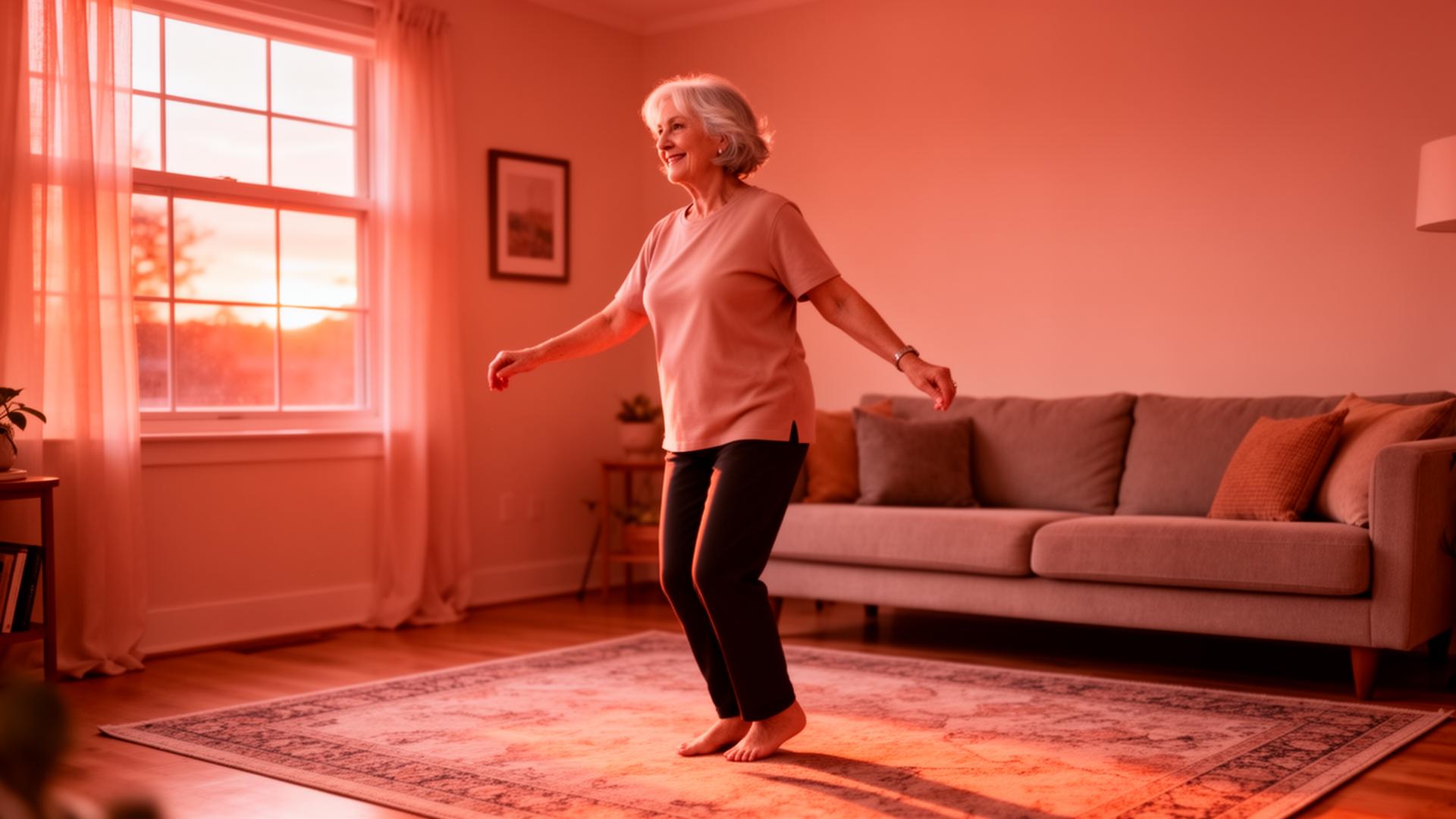
Low-impact cardio is the most underrated category in adult fitness. Not because it's been forgotten — because it's been mislabeled as "easy." It isn't. It's kind. Those are different things.
Done right, low-impact chair dance cardio raises your heart rate as effectively as running, burns roughly the same number of calories per minute at moderate intensity, and produces nearly all the same metabolic adaptations — without any of the joint pounding [1]. For seniors and anyone with knee, hip, or back history, it isn't a downgrade. It's the right tool.
This is what low-impact cardio for seniors actually involves, and why dance specifically may be the best version.
What "low-impact" actually means
Low-impact means one foot is on the ground at all times. No jumping. No running. No hopping. The shock absorption your body would otherwise do at every landing is eliminated.
What's NOT eliminated:
- Heart rate elevation
- Calorie burn
- Cardiovascular adaptation
- Mood and cognitive benefits
The misconception is that low-impact = low-intensity. They're independent variables. A 30-minute brisk walk with a steep incline can push your heart into the same zone as a 30-minute jog, with zero impact.
Why "low-impact" matters more after 50
Cartilage doesn't repair itself the way other tissues do. By the time you're 50, your knees and hips have absorbed roughly 50 years of impact, and the next 30 years matter a lot. Choosing low-impact options preserves the joints for longer use [2].
This isn't about being delicate. It's about being strategic. Many of the most consistently active 70- and 80-year-olds chose low-impact movement decades ago, not because they were forced to, but because they liked their knees.
The cardiovascular case for low-impact
A 2018 meta-analysis comparing low-impact and high-impact aerobic exercise in adults over 50 found equivalent improvements in VO2 max, blood pressure, and lipid profile when total energy expenditure was matched [3]. Translation: same cardiovascular benefit, no joint cost.
The same review found ADHERENCE was higher in the low-impact groups — people stuck with it. Over a 12-month follow-up, the low-impact participants had logged more total exercise time. The "easier" option produced more fitness in the end.
Categories of low-impact cardio worth knowing
Ranked roughly by cardiovascular intensity at maximal effort:
- Swimming — highest possible cardio with zero impact, but requires pool access
- Cycling (stationary or outdoor) — high cardio, knee-friendly if fitted properly
- Rowing — full-body, no impact, very high cardio ceiling
- Elliptical — gym-bound, decent cardio, low joint stress
- Brisk walking — accessible, moderate cardio, depends on terrain
- Dance — chair or standing, accessible, moderate-to-high cardio, full coordination training
- Tai Chi — gentle but real cardiovascular benefit at advanced levels
For seniors with home-based constraints, dance and walking dominate the list. Dance has the advantage of working independently of weather, daylight, and outdoor safety.
Why dance is the best low-impact cardio for many seniors
Dance does something the other options don't: it engages the brain. Coordinating limbs to music, remembering sequences, and processing rhythm all activate cognitive systems associated with reduced dementia risk [4]. A 2003 NEJM study famously found that dance was the only physical activity associated with significantly lower risk of dementia in chair exercises for older adults adults — more so than walking, cycling, or swimming [5].
The hypothesis is that dance combines:
- Aerobic exercise (cardiovascular benefit)
- Coordination (motor cortex)
- Memory (sequences and music)
- Social engagement (when done in class settings)
Even alone at home, the cognitive load of following choreography appears to deliver brain benefits that solo cardio doesn't.
A weekly low-impact cardio plan for seniors
The WHO guidelines call for 150 minutes of moderate cardio per week, distributed across most days [6]. For seniors specifically:
| Day | Cardio | Minutes |
|---|---|---|
| Mon | Chair dance | 25 |
| Tue | Walk | 30 |
| Wed | Chair dance | 25 |
| Thu | Walk or cycle | 30 |
| Fri | Chair dance | 25 |
| Sat | Long walk OR longer dance | 45 |
| Sun | Active rest — gentle mobility, light stretching | 15 |
Total: ~195 minutes of cardio, all low-impact. That's above the WHO floor, and the variety keeps you engaged.
How to know if you're working at moderate intensity
Three approximations, in increasing accuracy:
- Talk test — you can talk in short sentences, but not sing. (Easy, free, accurate enough.)
- RPE scale — rate perceived effort 0–10; moderate is 5–6, vigorous is 7–8.
- Heart rate — moderate is roughly 50–70% of your max heart rate. Max ≈ 220 minus age, very roughly.
Most chair cardio dance sessions land at moderate when you actually commit to the bigger arm movements. They drift to easy if you half-do them. The talk test is the simplest accountability.
Common mistakes in low-impact cardio
- Going too easy. "Low-impact" doesn't mean leisurely. If your heart rate doesn't elevate, you're not getting cardiovascular benefit. Push to moderate.
- Doing the same thing every day. Variety prevents adaptation plateaus AND keeps you mentally fresh.
- Skipping strength training. Low-impact cardio alone doesn't preserve muscle mass. Add 2x/week resistance work (bands, chair pushes, light weights).
- Ignoring warmup. Even gentle cardio benefits from 3–5 minutes of mobility first.
When to stop and check in
Stop and contact your doctor if you experience:
- New chest pain, pressure, or tightness during exercise
- Dizziness or near-fainting
- Unusual shortness of breath disproportionate to the effort
- Pain in joints that lasts more than 24 hours after a session
The first three are urgent. The fourth means you're probably doing too much too soon — back off for a week, then return at lower intensity.
The honest summary
Low-impact cardio is not the easy version. It's the smart version. For seniors specifically, it's the version that lets you keep training cardiovascular health for the next 20–30 years without burning out your joints. Dance has the additional benefit of training your brain at the same time.
Twenty-five minutes, most days. That's the protocol. It works.
Sources
- Gibala MJ, Little JP, et al. "Physiological adaptations to low-volume, high-intensity interval training in health and disease." J Physiol, 2012.
- Loeser RF, Goldring SR, et al. "Osteoarthritis: a disease of the joint as an organ." Arthritis Rheum, 2012.
- Cordes T, Bischoff LL, et al. "A multicomponent exercise intervention to improve physical functioning, cognition and psychosocial well-being in elderly nursing home residents: a systematic review and meta-analysis." BMC Geriatr, 2018.
- Predovan D, Julien A, et al. "Effects of dancing on cognition in healthy older adults: a systematic review." J Cogn Enhanc, 2019.
- Verghese J, Lipton RB, et al. "Leisure activities and the risk of dementia in the elderly." N Engl J Med, 2003.
- WHO. Physical activity guidelines. 2020.
Expert perspective
Cardio after 60 is not about jumping — it is about sustaining a slightly uncomfortable rhythm long enough for the heart to remodel. Dance does this without any of us noticing, which is exactly why it works.
— Dr. Mara Lindqvist, movement physiologist, Everdance
A 15-minute seated cardio session you can do without any pounding on the joints:
Put it into practice with Dance Cardio Burn.
High-energy, low-impact cardio in 20-minute sessions choreographed like a party. Fat burns, mood lifts, knees and back stay safe.
- 15 min daily sessions
- Low-impact modifications
- No equipment, 2 m²
- Cancel anytime
“Lost 3 kg without weighing food. I just kept pressing play because the music is that good.”

Lena is a doctor of physical therapy (DPT) who has spent 12 years working with adults 60+ on balance, arthritis recovery, and a confident return to movement after injury. She designs Everdance's chair and low-impact programs and writes everything we publish about ageing well.

Helena has spent two decades editing health journalism for European magazines. She fact-checks every Everdance article against primary sources.
Keep reading
All articles →
Is Dancing Good Exercise? What the Research Says
How Many Calories Does Dancing Burn? (by Style, 30 and 60 Minutes)