

Chair Exercises for Arthritis: A Joint-by-Joint Guide for Seniors
A 20-minute daily chair routine designed around the Arthritis Foundation's joint-protection principles — for hands, shoulders, hips, knees and spine.
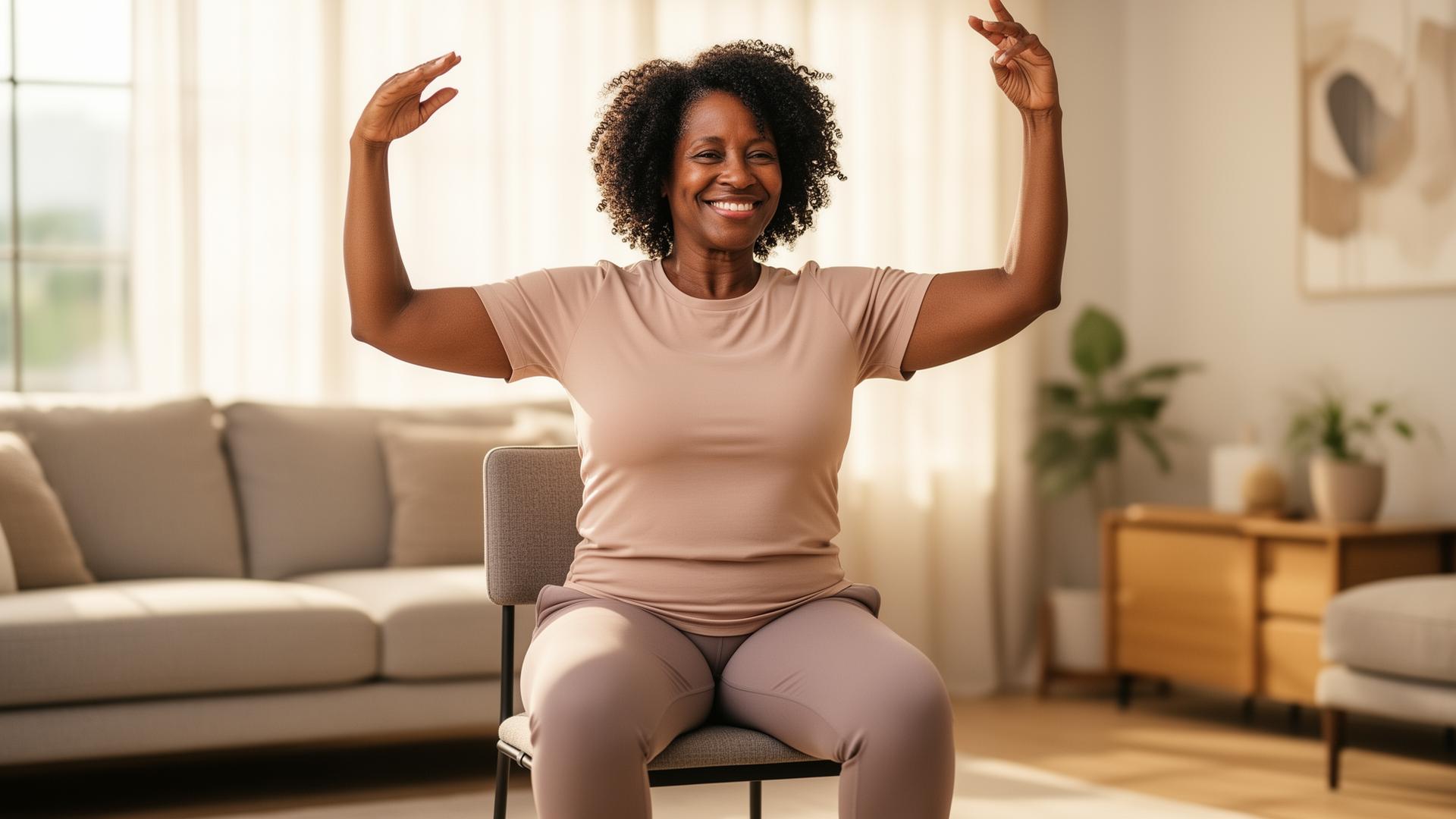
If you have arthritis, you've probably been told two contradictory things: "exercise is the best medicine" and "be careful, don't make it worse." Both are true, and the way to reconcile them is to choose movements that load the muscles around a joint without compressing or jarring the joint itself. That's exactly what a well-designed chair exercise routine does.
The Arthritis Foundation explicitly recommends low-impact, range-of-motion exercise as a first-line treatment for osteoarthritis in adults 60+, with chair-based routines specifically highlighted for women with knee, hip and lower-back involvement [1]. This guide walks through what to do, joint by joint.
How arthritis changes what counts as "good" exercise
Healthy cartilage gets nourished by movement: gentle compression draws synovial fluid in, then releases it out, in a sponge-like cycle. Without movement, cartilage degrades faster. With movement, even arthritic cartilage stays better-lubricated and less painful [2].
The catch: too much load (running, jumping, deep squats) accelerates wear. Too little load (sitting all day) starves the cartilage. The sweet spot is frequent, gentle, full-range movement — exactly what chair exercise provides.
"My arthritic patients who do a 20-minute chair routine 5 days a week report lower morning stiffness scores within 3 weeks. The dose matters more than the intensity — daily light movement beats twice-weekly hard sessions." — Dr. Anna Reyes, rheumatologist
Before you start: 4 ground rules
- Move within your pain-free range. A small stretch sensation is fine; sharp or pinching pain is not.
- Move slowly. Tempo of 3 seconds out, 3 seconds back. No swinging or bouncing.
- Warm up first. Cold joints crack and protest; warm ones don't. Five minutes of slow seated marching before any range-of-motion work.
- Stop and rest if a joint flares. A flare-up means you exceeded that joint's tolerance — drop the intensity by 50% for 2–3 days, then resume.
Joint-by-joint chair routine
Hands and wrists (3 min)
Arthritis often shows here first. Keep these moving daily:
- Fist-and-spread: Make a soft fist, hold 3 seconds, spread fingers wide, hold 3 seconds. × 10.
- Wrist circles: Slow circles, both directions, × 10 each way.
- Thumb-to-finger touches: Touch thumb to index, middle, ring, pinky in sequence, both hands. × 5 rounds.
Shoulders (3 min)
- Shoulder rolls: Slow circles forward × 8, back × 8.
- Wall-of-shame stretch: Reach arms overhead as far as comfortable, hold 5 seconds, lower. × 5.
- Cross-body reach: Right arm across chest, hold with left hand, breathe. 20 seconds each side.
Hips and lower back (4 min)
- Seated knee lifts: Lift one knee toward chest, hold 2 seconds, lower. Alternate. × 10 each.
- Seated hip rocks: Sit tall, gently rock pelvis forward (arch) and back (round) like a chair-version cat-cow. × 10.
- Figure-4 stretch (modified): If knee allows, place right ankle on left thigh, gentle forward lean. 20 seconds each side. Skip if uncomfortable.
Knees (3 min)
- Seated knee extensions: Slowly straighten one leg until parallel to floor, hold 3 seconds, lower. × 10 each.
- Toe-heel rocks: Press toes down, then rock to heels. × 20.
- Ankle pumps: Point and flex each foot. × 15 each.
Spine (3 min)
- Trunk twists: Arms crossed over chest, slowly twist left and right. × 8 each.
- Side bends: One arm reaches overhead and over, other hand rests on chair. × 5 each side.
- Forward fold (gentle): Hands slide down thighs toward floor as far as comfortable, slowly roll back up.
Total: about 16 minutes of movement. Combined with a 2-minute warm-up and 2-minute cool-down, you have a 20-minute daily arthritis routine.
The "dance" upgrade
The routine above works. The reason most arthritis routines fail isn't the exercises — it's the boredom. Doing the same set of stretches in silence every morning is depressing even if it helps.
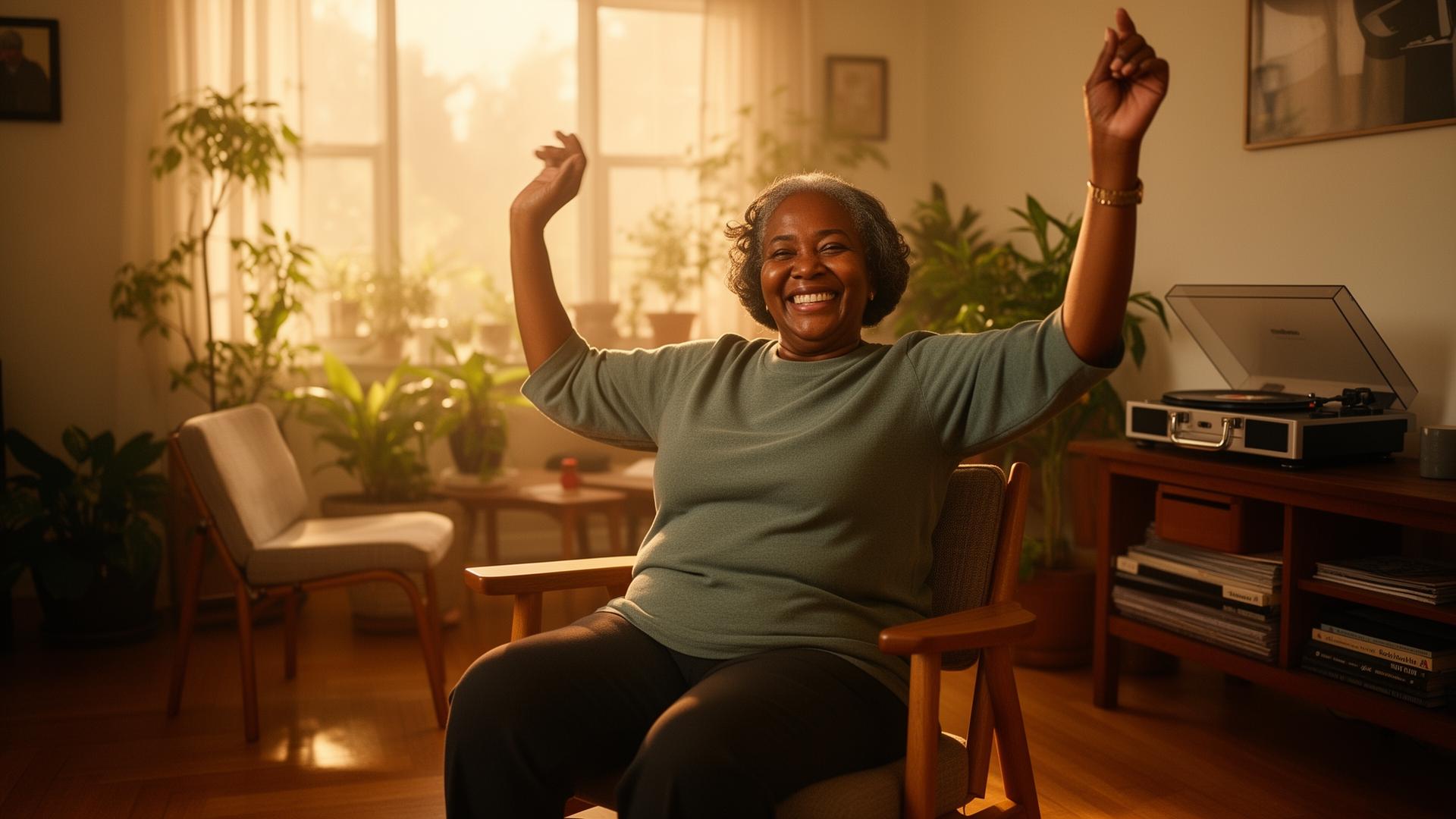
The Everdance Chair Yoga Dance Flow program threads these same movements into a music-led flow. Same hip rocks, same shoulder rolls, same knee extensions — but choreographed to gentle soul and jazz, so you stop counting and start grooving. Here's what that feels like:
For women with arthritis specifically, our Chair Balance Dance Flow and Gentle Dance for 70+ programs are most popular — both keep every movement inside the joint-protection range and never exceed moderate intensity.
How often, how long
| Goal | Frequency | Session length |
|---|---|---|
| Maintain current mobility | 4 × week | 15 min |
| Reduce daily stiffness | 5–7 × week | 15–20 min |
| Increase range of motion | 5 × week | 20–30 min |
| Recover from a flare | 2–3 × week | 10 min, gentle only |
The Arthritis Foundation recommends 150 minutes per week of low-impact movement, accumulated however works for you [1]. Five 30-minute sessions, ten 15-minute sessions — both count.
Foods that help (briefly)
Exercise is the foundation, but inflammation responds to diet too. The Mediterranean dietary pattern is the most evidence-backed for reducing arthritis-related inflammation [3]: fatty fish 2× per week, olive oil daily, leafy greens, nuts, berries. Reduce ultra-processed foods, added sugar, and excessive alcohol.
Don't expect supplements to replace movement. The evidence for glucosamine and chondroitin is weak; the evidence for daily gentle exercise is strong [4].
When to see a doctor
Don't power through these signs:
- Sudden joint swelling that doesn't go down with rest
- Joint pain at rest (not just on movement)
- Locking, catching or giving-way of a joint
- Pain that wakes you up at night
These can indicate progression that needs medical assessment, not more exercise.
Frequently asked
Will chair exercise wear out my joints faster?
The opposite. Cartilage health depends on gentle, repeated movement. The studies that find faster joint degeneration in active people involve high-impact or extreme-load activities, not chair routines [2].
Should I take pain meds before exercising?
Discuss with your doctor. If you take NSAIDs daily, no extra dose is usually needed. Don't take a pain med just to push through a workout — that's how injuries happen.
What about rheumatoid arthritis specifically?
The same principles apply, but avoid exercise during active flares (red, hot, swollen joints). The American College of Rheumatology recommends gentle range-of-motion work daily, with strength training added 2–3× per week in remission [5].
How do I know I'm doing it right?
You should feel slightly looser and warmer after the session. Soreness should ease within 48 hours. If pain is worse than before for more than 2 days, you went too far — scale back.
Can I combine this with my walking?
Yes, and you should. The two complement each other: walking builds cardiovascular endurance, chair exercise builds joint range and strength. Alternate days, or do chair exercise as a morning warm-up before walking.
Sources
[1]: Arthritis Foundation. Exercise and Arthritis. arthritis.org, accessed 2026. [2]: Bricca A, et al. Impact of exercise on articular cartilage in adults with knee osteoarthritis. British Journal of Sports Medicine, 2019. [3]: Forsyth C, et al. The effects of the Mediterranean diet on rheumatoid arthritis. Rheumatology International, 2018. [4]: Mayo Clinic. Glucosamine and chondroitin for osteoarthritis. mayoclinic.org, 2024. [5]: American College of Rheumatology. 2022 Guideline for Exercise, Rehabilitation, Diet, and Additional Integrative Interventions for RA.
Sources
The Joint-Protection Daily Routine, Set to Music You Won't Want to Skip.
A music-led chair flow that threads the Arthritis Foundation's range-of-motion exercises — gentle hip rocks, slow shoulder rolls, controlled knee extensions — into a 20-minute session you'll actually look forward to. Designed for arthritic joints from the ground up.
- Every movement stays inside the joint-protection range
- Slow, controlled tempo (3-second cadence) by design
- Pace cues let you scale down on flare days
- Daily 20-minute dose — the evidence-backed sweet spot

“Lost 3 kg without weighing food. I just kept pressing play because the music is that good.”

Mara studies how short bouts of rhythmic movement affect mood and cognition. She has authored over 40 peer-reviewed papers and dances daily in her kitchen.

Helena has spent two decades editing health journalism for European magazines. She fact-checks every Everdance article against primary sources.
Keep reading
All articles →
Seated Cardio Workout for Seniors: Get Your Heart Rate Up Without Standing
Chair Exercises for Seniors with Limited Mobility (2026 Guide)